




















































































Houthi missile and drone attacks on Saudi Arabia: Why India cannot afford to ignore the threat
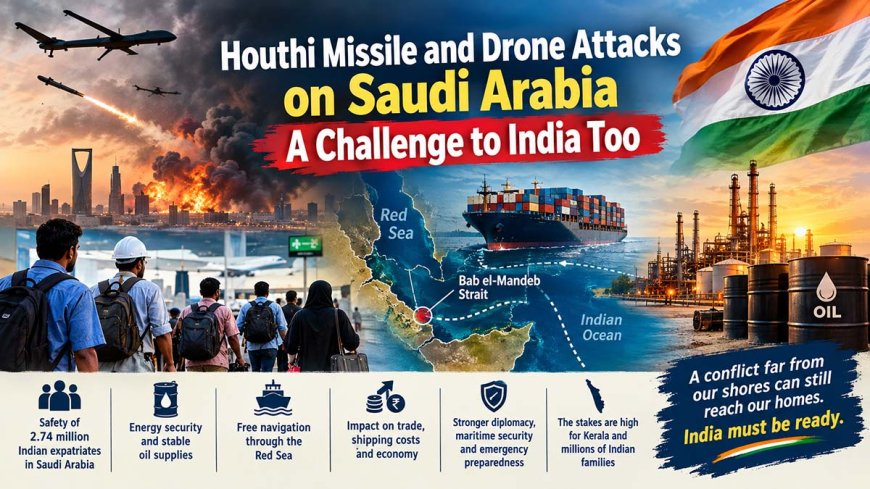
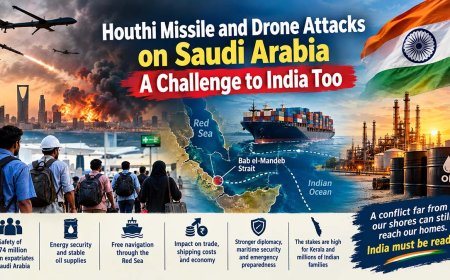
THE Houthi missile and drone threat to Saudi Arabia is not merely a regional security problem. It has direct implications for India's energy security, maritime trade, the safety of millions of Indian expatriates in the Gulf, and New Delhi's strategic interests in West Asia.
For India, the issue goes beyond condemning attacks on a friendly country. It raises a fundamental question: How prepared is India to protect its citizens, economic interests and energy lifelines if the security situation in the Gulf deteriorates further?
1. India's interests are directly at stake
The safety of millions of Indians
Saudi Arabia is home to approximately 2.74 million Indians, including professionals, technicians, healthcare workers and other expatriates.
They contribute to both the Saudi economy and India's foreign-exchange earnings through remittances.
Attacks on airports, cities and civilian infrastructure can put their lives at risk and disrupt their ability to work and travel. India's embassy has already advised Indian nationals to remain vigilant and follow local security instructions.
For Kerala, in particular, instability in Saudi Arabia is not a distant geopolitical concern. Thousands of families depend on the earnings of relatives working in the Gulf. A prolonged conflict could affect employment, remittances, air travel and family reunions.
Energy security and the price of oil
India imports a substantial share of its crude oil requirements. Any escalation that threatens Saudi oil facilities, export terminals or shipping routes could increase global oil prices and raise India's import bill.
Higher energy costs can translate into inflation, increased transport expenses and pressure on household budgets. Even if India's oil supplies are not directly interrupted, uncertainty in the international market can be costly.
India must therefore treat the protection of energy infrastructure and uninterrupted access to oil supplies as essential national interests.
The strategic importance of the Red Sea
The Bab el-Mandeb Strait, between Yemen and the Horn of Africa, is a vital passage connecting the Red Sea with the Gulf of Aden and the Indian Ocean. Houthi attacks on shipping threaten commercial vessels using this route, potentially forcing ships to take longer and more expensive journeys around Africa.
India has explicitly condemned attacks on Saudi territory and warned that threats to freedom of navigation through Bab el-Mandeb undermine regional security.
The consequences extend beyond oil. They can affect Indian exports, imports, shipping costs, insurance premiums and the movement of goods between India, Europe and other markets.
2. Why the missile and drone threat matters
Missiles and relatively inexpensive drones present a difficult challenge for modern air-defence systems. Even when incoming weapons are intercepted, defending against repeated attacks can consume costly interceptors and place pressure on surveillance and response capabilities.
The threat is not confined to military installations. Airports, oil facilities, ports and other civilian infrastructure can also be exposed. The current security situation in Saudi Arabia has prompted heightened travel warnings and concerns over airport operations.
For India, the lesson is clear: the security of a friendly country cannot be assessed solely by the strength of its conventional armed forces. Persistent attacks using missiles and drones can have wider economic and humanitarian consequences, even without a conventional invasion.
India should draw lessons for its own critical infrastructure, including energy installations, ports, airports and coastal facilities.
3. India's diplomatic balancing act
India maintains important relationships with Saudi Arabia, Iran, Israel and other countries in West Asia. It also has a strong interest in preventing the region from descending into a wider war.
This creates a difficult diplomatic balancing act. New Delhi must defend the principles of sovereignty, civilian protection and freedom of navigation without allowing itself to be drawn unnecessarily into regional rivalries.
India has already condemned the Houthi attacks on Saudi Arabia. Its challenge now is to combine clear diplomatic messaging with practical measures to protect Indian citizens and commercial interests.
Three priorities deserve particular attention:
- Stronger regional diplomacy: Work with Saudi Arabia, Oman and other regional partners to reduce tensions, encourage de-escalation and protect international shipping.
- Maritime security: Strengthen surveillance, information-sharing and coordination to protect Indian commercial shipping and seafarers.
- Emergency preparedness: Maintain updated evacuation plans, reliable communication with expatriate communities and contingency arrangements for airspace closures and disrupted transport.
India should also avoid assuming that every attack can be prevented through military deterrence alone. Sustainable security requires diplomatic engagement and measures to address the wider conflict.
4. The implications for Kerala
Kerala has a particular stake in the stability of Saudi Arabia and the Gulf region. Any prolonged conflict could affect families dependent on expatriate income, disrupt travel and create uncertainty for workers seeking employment abroad.
The state and the Union government should ensure that expatriate families have access to verified information, emergency contact arrangements and assistance if travel or employment is disrupted.
Equally important is responsible reporting. Unverified social-media videos and rumours can create panic among families whose relatives are in the affected areas. Official advisories and credible news sources should take precedence over speculation.
Conclusion: A warning India must take seriously
The Houthi missile and drone threat to Saudi Arabia is a challenge to India not because New Delhi must automatically become a party to another country's conflict, but because India's vital interests are inseparable from the security of the Gulf.
The lives of Indian expatriates, the stability of energy supplies, the safety of commercial shipping and the economic well-being of millions of families are all at stake.
India must respond with strategic foresight rather than panic: strengthen diplomatic engagement, protect maritime interests, prepare for emergencies and improve the resilience of critical infrastructure.
The central lesson is that a conflict thousands of kilometres from India's mainland can still reach Indian homes through oil prices, disrupted trade, endangered seafarers and the vulnerability of expatriate workers. For New Delhi, safeguarding national interests increasingly requires looking beyond its borders while avoiding unnecessary military entanglement.