

































































Wayanad AI and Data Center Park
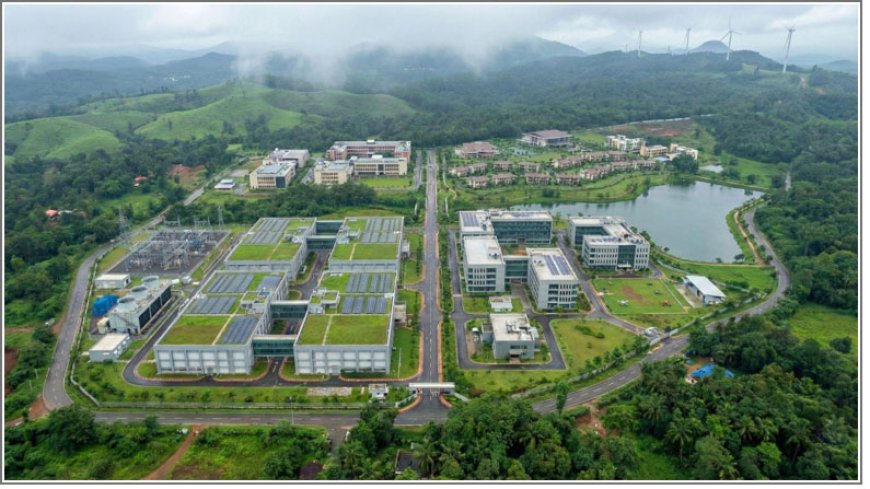
A Strategic Proposal positioning Kerala as the Nation's Green AI Capital
Project proposed by Malayalee Festival Federation
******************************************************
1. Background
KERALA has built a credible base in information technology over the past decade. In 2016–17, software exports from the three state IT parks—Technopark in Thiruvananthapuram, Infopark in Kochi and Cyberpark in Kozhikode—were about ₹8,000 crore. By 2024–25, exports from these parks had risen to approximately ₹26,191 crore, according to state announcements, with the number of companies rising to over 1,160 and tens of thousands of additional direct jobs created. Technopark alone is now estimated to generate about ₹14,575 crore in software exports annually.
This growth is, however, spatially concentrated. The benefits accrue mainly to the Thiruvananthapuram–Kollam corridor, the Kochi metropolitan region and Kozhikode. Wayanad, a hill district in North Kerala, remains largely outside the IT story. The Gross Domestic Product of Kerala 2011–12 to 2023–24 report shows that Wayanad’s Gross District Domestic Product (GDDP) at current prices in 2023–24 is ₹20,51,832 lakh—about ₹20,518 crore—out of a state GDDP of ₹11,46,10,867 lakh (₹11.46 lakh crore). Wayanad contributes roughly 2% of the state’s output and remains the lowest‑contributing district in relative terms.
At the same time, Kerala has adopted an ambitious digital agenda. The draft Kerala IT Vision 2031, presented at the ReCode Kerala 2025 seminar, sets out targets to generate about $50 billion in IT and emerging‑tech economic value, create around five lakh high‑value jobs by 2031, attract significant startup investment and build roughly 30 million square feet of additional IT space. It also envisages training about 10 lakh people in AI and related skills, and positions Kerala as a centre for ethical, sustainable AI.
Malayalee Festival Federation (MFF) was formed with a simple objective: to use the expertise and resources of global Malayalees for the socioeconomic development of Kerala. The Malayalee Festival Federation proposes that Kerala use one of its least industrialised districts to host one of its most advanced technologies.
The Wayanad AI and Data Center Park is conceived as a single integrated campus in southern Wayanad, developed as a public–private partnership, and designed to position Kerala as the nation’s leading destination for “green” AI compute and applied intelligence.
________________________________________
2. Kerala’s IT Trajectory
Kerala’s existing IT parks demonstrate what a well‑designed campus can deliver. Technopark, Infopark and Cyberpark together host over 1,100 firms, employ more than 150,000 people directly and support exports in the mid‑₹20,000‑crore range.
State policy has evolved accordingly. The Kerala IT Policy 2023 explicitly encourages private IT parks, global capability centres and PPP structures. In 2024, the Industries and Commerce Department notified the Industrial Land/Building (Allotment & Disposal) Regulations for KINFRA and KSIDC, providing a single regime for allotting and leasing industrial land and buildings, with lease terms up to 60 years generally and extendable to 90 years for large projects above specified thresholds (for example, investments of ₹100 crore and minimum land and employment norms).
Wayanad’s economic structure, by contrast, is dominated by agriculture, plantations and tourism. The GDP figures show steady growth over the past decade but from a low base; in 2011–12 the district’s GDP was about ₹7,08,806 lakh and has since risen to ₹20,51,832 lakh. The district consistently accounts for the smallest share of state output. Yet Wayanad is not an institutional blank slate. The KINFRA Small Industries Park at Kalpetta operates on around 50 acres, hosting non‑polluting industries and food‑processing units with utilities and single‑window facilitation.
This combination—a low starting point, an existing park‑development precedent and state‑level policy support for IT and private parks—creates space for a new, differentiated campus in Wayanad.
________________________________________
3. AI, Data Centres and Wayanad’s Climate and Connectivity
AI workloads demand large‑scale compute power and, with it, large amounts of energy and cooling. Studies and industry norms indicate that cooling can account for a significant share of a data centre’s total energy use, especially in high‑density AI deployments.
Wayanad’s climate is well‑suited to mitigate this. The district’s mean annual temperature is in the mid‑20s Celsius; Thiruvananthapuram’s is closer to 27–28°C. The plateau terrain and forest cover moderate extremes and generally keep air cleaner than in many urban or coastal areas.
For AI‑oriented data centres this means a lower cooling load and more hours where outside air can be used for cooling, less dust and particulate matter to filter, and reduced corrosion of sensitive hardware.
On this basis, a Wayanad‑based AI data‑centre campus can reasonably target lower operating expenditure than a coastal equivalent, while also offering a more robust “green compute” narrative in an era of rising scrutiny of data‑centre emissions.
Connectivity supports this proposition. The preferred location in southern Wayanad, along the Kalpetta–Nilambur corridor, lies roughly 75–85 km from Calicut International Airport. Standard road travel times between the airport and Kalpetta are in the range of about two to two‑and‑a‑half hours, depending on traffic and the Thamarassery Ghat stretch.
Cochin International Airport is about 210–260 km away, with typical road journeys of four to five hours. NH 766 connects Kozhikode to Kalpetta and onward to Mysuru and Bengaluru, providing access to major IT labour markets in Karnataka as well as Kerala’s own northern belt.
Connectivity is improving. The Kozhikode–Wayanad Tunnel Road (Anakkampoyil–Kalladi–Meppadi twin‑tube tunnel) has secured environmental clearance from the Ministry of Environment, Forest and Climate Change.
The project involves an approximately 8.1 km twin tunnel with a four‑lane approach road, designed to provide an alternative to the congested and landslide‑prone Thamarassery Ghat section. Once commissioned, it is expected to shorten the Kozhikode–Wayanad route, reduce travel times and improve reliability for freight and passenger movement.
Taken together, Wayanad’s climate and connectivity make it a credible location for an AI‑centric campus that emphasises energy efficiency and environmental performance.
________________________________________
4. Global Precedents and Kerala’s ‘Green AI’ niche
AI‑centred clusters elsewhere provide useful reference points.
Dubai’s AI & Web3 Campus in the DIFC Innovation Hub is positioned as a regulated environment for future‑tech firms, with a goal of hosting more than 500 companies by 2028, supported by deep capital and regional data‑centre investments.
Andhra Pradesh’s initiatives around Visakhapatnam hinge on a major anchor investment by a global technology firm (Google) to build an AI cloud and data hub. Pittsburgh has harnessed Carnegie Mellon University’s expertise to reposition itself as a robotics and AI centre.
China is knitting together inland data‑centre clusters into a national “integrated computing network” to support domestic AI. In each case, the cluster claims a specific niche in the AI value chain and bundles infrastructure, talent and regulation.
Within Kerala, the most relevant precedent is the AI Tech City approved as Infopark Phase III in Kochi, a 300‑acre urban AI township concept with carbon‑negative and zero‑waste aspirations.
The Wayanad AI and Data Center Park is designed to complement, not duplicate, these efforts. While Kochi’s AI Tech City is an urban, transit‑linked cluster, Wayanad can position itself as a hill‑station campus specialising in:
● Energy‑efficient AI and data‑centre infrastructure.
● Training, Inference and Applied AI for agriculture, Fintech, Biotech..etc
This niche aligns with the Kerala Artificial Intelligence Mission and the targets set in IT Vision 2031, and offers a credible basis for presenting Kerala as the nation’s principal “Green AI Capital”.
________________________________________
5. Project concept: Wayanad AI and Data Center Park
The Wayanad AI and Data Center Park is conceived as a 100–200 acre park that will focus on AI compute and data‑centre infrastructure, while the remaining area accommodates application‑layer offices, training facilities, housing and green belts.
Land will be selected on non‑fragile plateau terrain, screened for landslide and flood risk and set back from ecologically sensitive patches, in line with recent experience of extreme rainfall and slope instability in the district. A full Environmental Impact Assessment (EIA) will define final buffers and land‑use constraints.
5.1 Functional zoning
Within the campus, land use will be structured into four principal zones, all under the single project name:
Zone Approximate share of campus Primary function
A about 25% Compute and utilities: Tier III/IV data centres, GPU clusters, substations and utility yards
B about 40% Application layer: AI start‑ups, enterprise development centres, robotics and IoT labs
C about 15% Knowledge and skills: AI training academy, applied research centres
D about 20% Lifestyle and green belt: housing, convention centre, recreation and ecological buffers
Zone A will host modular Tier III/IV data‑centre shells designed for high‑density AI workloads, with suitable power densities and structural specifications. Power will be provided through a dedicated substation with dual grid feeds, supported by on‑site solar generation and potential wind or hybrid renewable sources. Cooling architectures will combine liquid cooling, hot‑aisle or cold‑aisle containment and ambient‑air‑assisted heat exchange, explicitly leveraging Wayanad’s lower temperatures to reduce power usage effectiveness.
Zone B will contain flexible office space for AI start‑ups and scale‑ups and built‑to‑suit areas for Indian and global enterprises. A robotics and IoT laboratory with access to nearby plantations and rural terrain will allow field testing of agricultural robots, drones, sensor networks and climate‑monitoring systems.
Zone C will host the AI Training Academy and an applied research centre. The academy will focus on mid‑career upskilling and entry‑level programmes in AI application development, data engineering, prompt engineering, AI ethics, RLHF operations and domain‑specific analytics. It will support and extend the state’s objective of training 10 lakh people in AI and emerging technologies.
Zone D will provide walking‑to‑work eco‑residences, serviced apartments, schools and healthcare facilities at an appropriate scale, together with a convention and retreat centre. Landscaped green belts and ecological buffers will protect local biodiversity, manage surface water and maintain Wayanad’s character as a hill‑station environment.
All four zones, together, comprise the Wayanad AI and Data Center Park. There is no separate “outer” park; the AI and data‑centre identity applies to the entire campus.
________________________________________
6. Infrastructure, sustainability and technical preparation
The Wayanad AI and Data Center Park will be built to standards appropriate for AI‑centred infrastructure.
On the infrastructure side, this implies Tier III/IV‑ready data‑centre shells with robust electrical and mechanical systems; clear separation of critical and non‑critical loads; diverse fibre paths connected to the Kerala Fibre Optic Network and private carriers; and adequate space and load‑bearing capacity for current and next‑generation AI hardware.
On the sustainability side, the campus will be designed as a water‑positive and low‑emission site. Rainwater harvesting, storage and reuse will be integrated into the master plan. Sewage and industrial effluent will be treated to standards that support near‑zero discharge into surrounding land and water bodies. Noise and vibration from backup generators, chillers and cooling towers will be actively managed, particularly near residential and buffer zones. Lighting at the campus edge will be wildlife‑sensitive where it abuts natural areas.
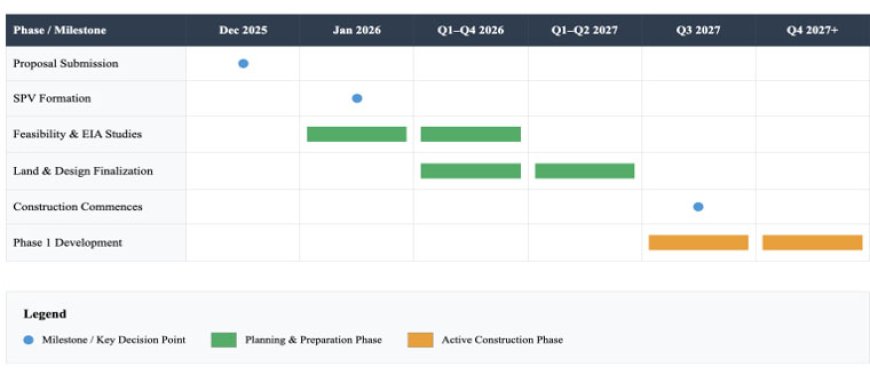
Before detailed design and financial closure, four sets of studies will be commissioned:
1. A technical and feasibility study, to examine power, cooling and connectivity requirements for Tier III/IV data‑centre uptime in Wayanad’s terrain and to define redundancy architectures and integration with the tunnel corridor and broader road network.
2. A project costing and phasing study, setting out civil, mechanical, electrical, ICT and township components and sequencing them into realistic phases linked to anchor‑tenant commitments.
3. A comprehensive Environmental Impact Assessment, covering hydrology, landslide and disaster risk, biodiversity, water and waste systems, and specifying mitigation, monitoring and compliance measures.
4. A capital‑raising and PPP strategy, defining the SPV structure, the mix of government equity (through land), domestic and foreign capital and the revenue model for land leases, shared infrastructure and services.
All the studies will be completed by 31 December 2026.
________________________________________
7. Economic and employment impact
Kerala’s own IT parks provide a robust benchmark for the potential of the Wayanad AI and Data Center Park.
Technopark, spread over about 760 acres across its phases, supports around 80,000 direct jobs and exports of approximately ₹14,575 crore, implying around 105 direct jobs per acre and nearly ₹19 crore in exports per acre.
SWOT analysis -
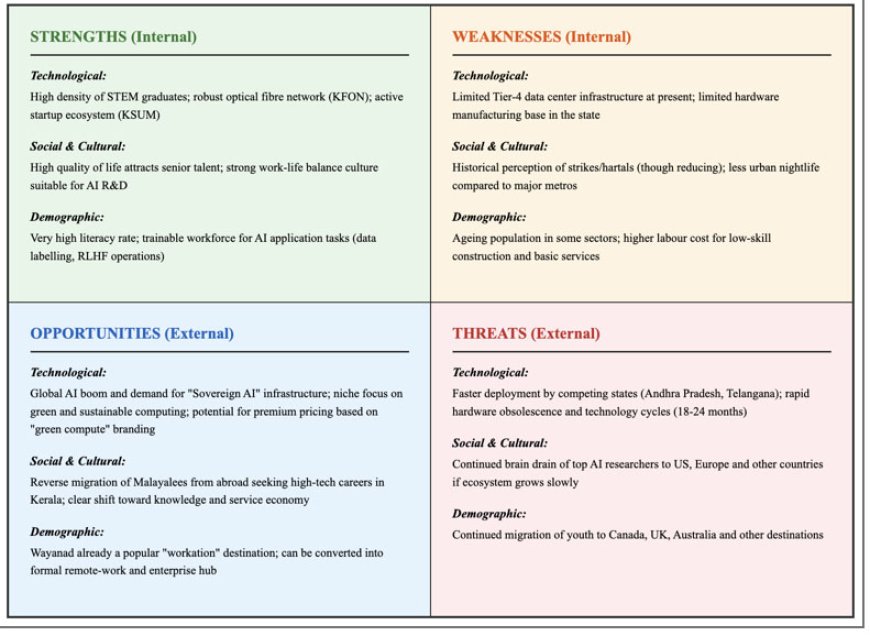
A Wayanad campus of 100 - 200 acres, can reasonably aim for job and output densities in the same order of magnitude, especially given the focus on higher‑value AI workloads. At full development, the park is expected to support:
● Direct employment in the range of 25,000–35,000 jobs, corresponding to roughly 100–140 jobs per developed acre.
● Indirect employment in the range of 50,000–70,000 jobs in services, construction, logistics, tourism and local enterprises, using the 1:2 relationship observed in Technopark and Infopark between direct and indirect jobs.
● Annual exports or high‑value output of about ₹4,000–₹5,000 crore, corresponding to exports of roughly ₹16–₹20 crore per developed acre.
Against Wayanad’s current GDP of around ₹20,518 crore, the park’s output at maturity would add roughly 20–25% to the district’s present‑day economic activity. Relative to Kerala’s GSDP—about ₹11.46 lakh crore in 2023–24 and an estimated ₹13.11 lakh crore in 2024–25—the park’s output would be in the range of 0.3–0.4% of state output, with a higher share of incremental growth.
For the first five years, a 100–200 acre initial development of the AI and data‑centre core, with supporting office space, training and township components, is expected to involve capital outlays on the order of ₹2,500–₹3,000 crore, excluding tenants’ IT hardware. This implies development costs of roughly ₹15–₹20 crore per acre. By around 2030, the park is expected to support 15,000–20,000 direct jobs and generate annual state‑output contributions in excess of ₹3,000 crore as data‑centre utilisation and AI service exports ramp up.
These figures frame the scale of the opportunity: a single campus in Wayanad that materially lifts both district‑level and state‑level economic performance, while advancing Kerala’s goal of becoming the nation’s Green AI Capital.
________________________________________
8. Governance, PPP structure and implementation
The Wayanad AI and Data Center Park is proposed as a single project implemented through a Special Purpose Vehicle.
The Government of Kerala, acting through KSITIL, KINFRA or KSIDC as nodal agency, would identify and allocate 100 - 200 acres of suitable plateau land in southern Wayanad under the Unified Industrial Land/Building (Allotment & Disposal) Regulations 2024, provide core external infrastructure (roads, power and bulk water) and operate a single‑window clearance mechanism aligned with the IT Policy 2023 and IT Vision 2031.
The Malayalee Festival Federation would act as project promoter, through the Wayanad AI and Data Center Park Project Promotion Council, bringing together global Malayalee investors and experts. The Council would support master planning, coordinate diaspora investment, assist in attracting anchor data‑centre and AI tenants and manage international branding.
Private partners would include data‑centre developers and operators, IT and AI companies, start‑ups and township developers, operating under the unified land regulations and agreed sustainability and design standards. The SPV could adopt a mixed SEZ and non‑SEZ structure so that export‑oriented and domestic‑facing units can co‑exist.
An indicative timetable, subject to Government approval, is as follows:
● In‑principle approval and nodal‑agency designation in early 2026.
● SPV formation, land identification and commissioning of feasibility, costing and environmental studies during 2026, with completion by December 2026.
● Financial closure for the first phase, finalisation of detailed designs and commencement of core infrastructure and data‑centre shells during 2027.
● Initial data‑centre and office blocks, along with the AI Training Academy, becoming operational in the 2029–2030 window.
The timetable will be refined by the SPV once land parcels and anchor investors are confirmed.
________________________________________
9. Requested actions from the Government of Kerala
MFF respectfully requests that the Government of Kerala consider the following four actions.
First, to agree in principle to the development of the Wayanad AI and Data Center Park as a 100 - 200 acre integrated AI and IT campus in southern Wayanad, and to instruct the relevant departments to identify and earmark suitable non‑fragile plateau land with clear zoning for AI/data‑centre, office, training, township and green‑belt uses.
Second, to designate KSITIL, KINFRA or KSIDC as the nodal agency for structuring the park under the Kerala IT Policy 2023 and the Unified Industrial Land/Building (Allotment & Disposal) Regulations 2024, including provision for long‑term (60–90 year) leases for investments above the notified thresholds.
Third, to authorise and fund the required technical, costing and environmental studies, in collaboration with MFF and relevant expert institutions, with a target completion date of 31 December 2026.
Fourth, to mandate joint promotion of the Wayanad AI and Data Center Park by the nodal agency and MFF, through the Project Promotion Council, including preparation of a detailed master plan, financial model and investor‑outreach programme focusing on domestic IT and AI firms, global data‑centre and cloud operators, and GCC‑based Malayalee investors.
These actions would signal that Kerala intends to lead the country not only in the use of AI, but in the provision of secure, sustainable and sovereign AI compute.