
























































UN faces ‘imminent financial collapse’ as unpaid dues touch ‘record’ billion dollars
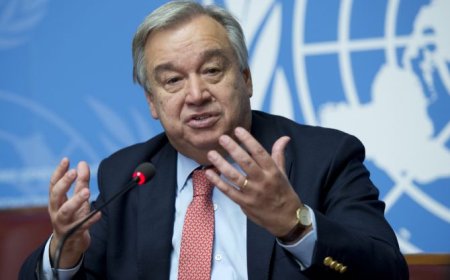
United Nations Secretary-General Antonio Guterres cautioned that the world body is heading towards an “imminent financial collapse.”

UNITED Nations Secretary-General Antonio Guterres warned on Friday that the world body is on the brink of financial collapse. He cautioned that the world body is heading towards an "imminent financial collapse" as member states fall behind on annual contributions and structural funding issues deepen.
According to Al Jazeera, Guterres recently circulated a letter to all UN member nations, warning of a severe financial crunch.
He wrote in a letter to all 193 member states that they had to honour their mandatory payments or overhaul the organisation's financial rules to avoid collapse, the BBC reported.
In the letter, he reportedly urged governments to either reform budgetary rules or face "the very real prospect of the financial collapse of our organization." He also called on countries to clear their outstanding dues.
In the January 28 letter seen by Bloomberg News, Guterres said that a budget rule requiring the UN to return any unspent money has made it especially difficult for the organisation to stay liquid. “The more we save, the more we are penalised,” he wrote.
Unpaid dues reached a record...
Guterres said that by the end of 2025, unpaid dues had reached a record $1.57 billion, without identifying the countries responsible, according to Al Jazeera.
Reiterating the urgency of reform, he warned, “Either all Member States honour their obligations to pay in full and on time - or Member States must fundamentally overhaul our financial rules to prevent an imminent financial collapse.”
Is Trump responsible?
The institution has long been strapped for cash, but it has been especially squeezed since the start of President Donald Trump’s second term.
The BBC claimed that the US did not pay its contribution to the UN's regular budget in 2025 and offered only 30 per cent of its expected funding to UN peacekeeping operations.
Besides, Trump's administration announced plans to withdraw from several UN agencies and has also promoted what Trump calls a "Board of Peace" initiative.
The 'Board of Peace' panel was initially meant to help administer Gaza after an Israel-Hamas truce, but Trump has cast it as a substitute for a UN he said has failed to live up to its potential.
Against this backdrop, Al Jazeera reported that some experts believe the initiative is aimed at sidelining the United Nations.
Commenting on the proposal, Louis Charbonneau, UN director at Human Rights Watch, said, “Trump's board appears to be a kind of pay-to-play, global club, judging from the $1 billion fee for permanent membership.”
He added, "Instead of handing Trump $1 billion checks, governments should work together to protect the UN and other institutions established to uphold international human rights and humanitarian law, the global rule of law, and accountability."
The US officially left the UN's World Health Organisation (WHO). It had refused to pay its 2024 and 2025 dues despite, WHO lawyers say, being legally obliged to do so. Other agencies are also making huge cuts.
How much does US owe UN?
The US accounts for 22 per cent of the organisation's core budget, followed by China with 20 percent.
According to Bloomberg, the US still owes the UN about $1.4 billion in arrears for years past, on top of a $767 million bill for this year's budget, according to a senior UN official.
In 2025, the White House did not pay any of its $826 million in dues. The US reportedly pledged $2 billion to the organisation’s humanitarian arm in December, while refusing to pay its mandatory fees.
UN's budget
Guterres has been trying to scale back spending and reverse funding issues since 2024. Already, the UN cut this year’s budget by 7 per cent relative to the year before.
Under the existing system, UN membership fees are calculated based on factors such as national gross domestic product, debt levels and economic capacity, with the United States contributing 22 per cent of the core budget, followed by China at 20 per cent.
Even as financial pressures mount, the UN earlier this month approved a $3.45 billion budget for 2026, reflecting a 7 per cent reduction from last year as the organisation attempts to curb spending.
However, despite these cost-cutting steps, Guterres cautioned in his letter that the UN could exhaust its cash reserves by July.
He also pointed to what he described as an outdated rule that requires the organisation to return hundreds of millions of dollars in unused funds to member states each year.
Highlighting the impact of this mechanism, Guterres said, as reported by Al Jazeera, "In other words, we are trapped in a Kafkaesque cycle, expected to give back cash that does not exist."
Reflecting the scale of the challenge, figures published on the organisation's website show that as of Thursday, only 36 of the UN's 193 member countries had fully paid their regular 2026 contributions.