



















































































Dying oceans, burning soil: The humanitarian crisis hidden in India’s fields
Follow TNM's WhatsApp channel for news updates and story links.The United Nations recently released its Third World Ocean Assessment, and its conclusions are as sobering as they are undeniable. Ocean temperatures are climbing at an unprecedented rate, sea levels are accelerating, and the greatest relative warming is concentrated right here in our backyard, the southern Indian Ocean.For a long time, public discourse has treated ocean health as a distant, maritime issue. That is a dangerous mistake. What happens in our oceans dictates the weather on our land. Today, India stands at the perilous intersection of an ecological feedback loop and a profound humanitarian crisis. The crisis of our seas is directly fuelling an existential threat to the flesh and blood of our nation: our farmers.This is no longer a debate about economic percentages or GDP growth. This is a matter of basic human survival, dignity, and the well-being of the people who feed us.The brutal toll of heat stressWhile rising sea levels slowly redraw our coastlines, extreme heat waves, supercharged by warming oceans, are ravaging our mainland. A landmark study released this month by the Energy and Climate Intelligence Unit (ECIU) reveals a terrifying reality: heat stress is actively stealing the working hours and the health of our farmers.According to the data, an average agricultural worker in India now loses 648 potential working hours per year simply because the midday sun has become a biological hazard. When measured against standard agricultural work cycles, this means our farmers are losing nearly 20% of their total productive time. Let that sink in. This is the equivalent of 54 full working days. Nearly two months of labour are being wiped out annually because conditions are too dangerous for a human being to survive outside.Behind these numbers lies a brutal human reality. Working in 45°C+ heat isn't just uncomfortable; it could cause severe chronic dehydration, heat exhaustion, kidney disease, and cardiovascular strain. We are asking our parents, brothers, and sisters in the villages to choose between tending to their crops or risking their lives under an unlivable sky. This is not a distant projection for 2050; it is a full-blown humanitarian crisis on the ground today.Gen Z’s empathy over economicsFor the younger generation, this crisis hits home not because of supply chains, but because of basic human empathy. Gen Z looks at the world through a lens of climate justice. They see that the very people who bear the absolute least responsibility for global carbon emissions, our traditional farmers and smallholders, are the ones paying the heaviest price with their health and lives.A society cannot call itself developed if its progress is built on the backs of a workforce forced to labour in agonising, life-threatening conditions. Protecting our farmers is the defining moral obligation of our time.When we look globally for answers, we see that technological defiance can be used to shield human beings from harsh environments in Israel.By all objective measures, Israel should never have been able to sustain agriculture. It is a nation where over half the geography is a literal desert, plagued by extreme heat and acute water scarcity. Yet, they pulled off a modern miracle. They didn't just innovate to save money; they innovated to survive. They pioneered automated drip irrigation; revolutionised wastewater recycling, thereby reusing an astonishing 86% and commercialised precision agritech that utilises sensors and AI to monitor crops remotely.The greatest achievement of Israel’s agritech is that it decoupled farming from gruelling, relentless manual exposure to hostile weather. They engineered an ecosystem to outsmart the environment, reducing the hours humans have to spend suffering under a punishing sun. If Israel can turn a barren desert into a safe, technologically shielded breadbasket, India can and must use technology to protect its farmers from the rising heat.A new blueprint for compassionate governanceWe cannot afford defensive, reactive governance that treats people as mere cogs in a machine. If India is to protect its people, we must pioneer a proactive, multi-pronged strategy centred entirely around human well-being.●A human-centric labour framework: We must structurally adapt our agricultural labour systems to the climate reality. This means encouraging heat-resilient work shifts and shifting heavy labour entirely to the cooler dawn and dusk hours while legally enforcing the creation of localised rural hydration hubs. In the Indian context, such drastic changes can only be pushed through if new-age technologies are used to substitute manual labour and the farmer is educated to trust the machines.●Aggressive, welfare-driven agritech adoption: Like the Israeli model, we must pour public capital into technologies that take the physical burden off the farmer. This means rapid, subsidised deployment of automated irrigation; climate-r
Follow TNM's WhatsApp channel for news updates and story links.
THE United Nations recently released its Third World Ocean Assessment, and its conclusions are as sobering as they are undeniable.
Ocean temperatures are climbing at an unprecedented rate, sea levels are accelerating, and the greatest relative warming is concentrated right here in our backyard, the southern Indian Ocean.
For a long time, public discourse has treated ocean health as a distant, maritime issue. That is a dangerous mistake. What happens in our oceans dictates the weather on our land.
Today, India stands at the perilous intersection of an ecological feedback loop and a profound humanitarian crisis. The crisis of our seas is directly fuelling an existential threat to the flesh and blood of our nation: our farmers.
This is no longer a debate about economic percentages or GDP growth. This is a matter of basic human survival, dignity, and the well-being of the people who feed us.
The brutal toll of heat stress
While rising sea levels slowly redraw our coastlines, extreme heat waves, supercharged by warming oceans, are ravaging our mainland. A landmark study released this month by the Energy and Climate Intelligence Unit (ECIU) reveals a terrifying reality: heat stress is actively stealing the working hours and the health of our farmers.
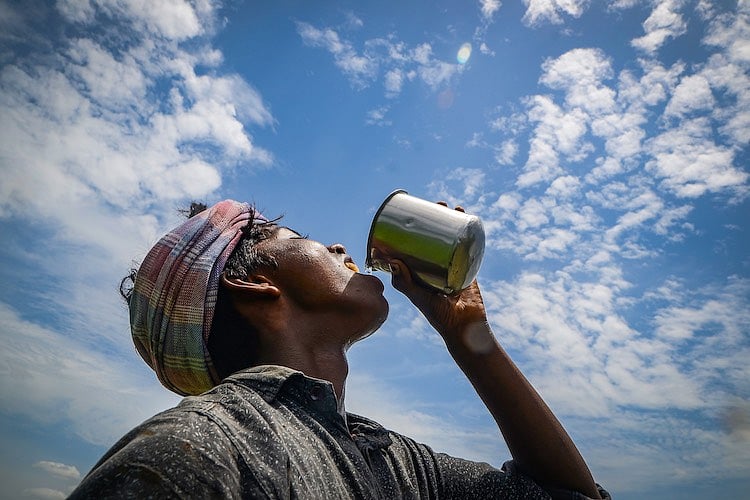
According to the data, an average agricultural worker in India now loses 648 potential working hours per year simply because the midday sun has become a biological hazard.
When measured against standard agricultural work cycles, this means our farmers are losing nearly 20% of their total productive time. Let that sink in. This is the equivalent of 54 full working days. Nearly two months of labour are being wiped out annually because conditions are too dangerous for a human being to survive outside.
Behind these numbers lies a brutal human reality. Working in 45°C+ heat isn't just uncomfortable; it could cause severe chronic dehydration, heat exhaustion, kidney disease, and cardiovascular strain. We are asking our parents, brothers, and sisters in the villages to choose between tending to their crops or risking their lives under an unlivable sky. This is not a distant projection for 2050; it is a full-blown humanitarian crisis on the ground today.
Gen Z’s empathy over economics
For the younger generation, this crisis hits home not because of supply chains, but because of basic human empathy. Gen Z looks at the world through a lens of climate justice. They see that the very people who bear the absolute least responsibility for global carbon emissions, our traditional farmers and smallholders, are the ones paying the heaviest price with their health and lives.
A society cannot call itself developed if its progress is built on the backs of a workforce forced to labour in agonising, life-threatening conditions. Protecting our farmers is the defining moral obligation of our time.
When we look globally for answers, we see that technological defiance can be used to shield human beings from harsh environments in Israel.
By all objective measures, Israel should never have been able to sustain agriculture. It is a nation where over half the geography is a literal desert, plagued by extreme heat and acute water scarcity. Yet, they pulled off a modern miracle. They didn't just innovate to save money; they innovated to survive. They pioneered automated drip irrigation; revolutionised wastewater recycling, thereby reusing an astonishing 86% and commercialised precision agritech that utilises sensors and AI to monitor crops remotely.
The greatest achievement of Israel’s agritech is that it decoupled farming from gruelling, relentless manual exposure to hostile weather. They engineered an ecosystem to outsmart the environment, reducing the hours humans have to spend suffering under a punishing sun. If Israel can turn a barren desert into a safe, technologically shielded breadbasket, India can and must use technology to protect its farmers from the rising heat.
A new blueprint for compassionate governance
We cannot afford defensive, reactive governance that treats people as mere cogs in a machine. If India is to protect its people, we must pioneer a proactive, multi-pronged strategy centred entirely around human well-being.
●A human-centric labour framework: We must structurally adapt our agricultural labour systems to the climate reality. This means encouraging heat-resilient work shifts and shifting heavy labour entirely to the cooler dawn and dusk hours while legally enforcing the creation of localised rural hydration hubs. In the Indian context, such drastic changes can only be pushed through if new-age technologies are used to substitute manual labour and the farmer is educated to trust the machines.
●Aggressive, welfare-driven agritech adoption: Like the Israeli model, we must pour public capital into technologies that take the physical burden off the farmer. This means rapid, subsidised deployment of automated irrigation; climate-resilient crop varieties that require less intensive midday monitoring; and drone-based precision farming to minimise manual field labour.
●A sovereign shield for primary producers: From implementing radical circular economies to stop urban plastic from choking our marine life to safeguarding our coastal ecosystems, our policies must protect our primary producers. Traditional fishermen and farmers are the front lines of our country, and their health is our national health.
The narrative shouldn't be "We need to write new laws.” We have the laws. We have the data. What we lack is the political will to enforce them at the grassroots level, protect our outdoor workers, and fund the infrastructure to reuse our water.
A realistic look at where India stands as on date
Plastic and waste
Steps taken: India implemented a massive Extended Producer Responsibility (EPR) framework. The government rolled out severe updates, including mandatory QR codes on packaging for real-time tracking, 30% recycled material requirements for rigid plastics, and massive fines for non-compliance.
The gap: While multinational corporations are scrambling to comply to avoid getting shut down, local enforcement is in shambles. Walk into any local vegetable market or kirana store in Hyderabad, Chennai, or Mumbai, and thin, single-use plastic bags are still widely used. The municipal corporations simply do not have the manpower to enforce bans at the retail level, and our river mouths remain severely clogged.
Wastewater Recycling
Steps taken: India is waking up to this opportunity. States are trying to take it seriously. There are also incredible private-sector innovations underway, with local startups deploying systems that recycle up to 99% of wastewater in major commercial hubs.
●The gap: Nationally, the scale is still dangerously low. Urban India generates roughly 112 billion litres of wastewater every single day. Out of that, only about 28% is treated, and a mere 8% is actually reused. Compare that to Israel, which reuses 86% of its wastewater for agriculture. The remaining 72% of India's untreated wastewater flows straight into our lakes, rivers, and groundwater tables, poisoning the very resources we rely on.
‘Sponge cities’ and urban flooding
●Steps taken: Following disastrous urban floods in Chennai, Bengaluru, and Hyderabad, municipal bodies have repeatedly brought up ‘Sponge Cities’ frameworks in town planning meetings. There are minor projects dedicated to desilting lakes and building rainwater harvesting pits. Tamil Nadu, under the erstwhile Chief Minister Jayalalitha, rolled out one of India’s most successful rainwater harvesting initiatives in 2001. The policy made it mandatory for all new constructions to install RWH structures. Replicating the same across states and cities is the need of the generation.
●The gap: True sponge cities require a complete overhaul of urban design: permeable asphalt, massive interconnected green spaces, and a strict ban on building over natural wetlands. Instead, encroachment of water bodies continues. As real estate expands, lakes are paved over, natural stormwater drains are choked with concrete, and groundwater recharge is severely disrupted. Our cities are acting like giant concrete mirrors for heat rather than sponges for water.
Labour protection and heat stress
●Steps taken: The National Disaster Management Authority (NDMA) has pushed states to develop Heat Action Plans (HAPs). Cities like Ahmedabad and parts of Telangana have guidelines recommending that outdoor work be shifted during peak heat hours.
●The gap: These plans are largely advisory, not legally binding. For a traditional farmer or an informal day labourer, missing work during the day means starving at night. Because there are no state-backed wage compensation frameworks for ‘heat days’, workers are forced to push through dangerous temperatures. The 54 working days lost to heat stress are treated as an individual tragedy for the farmer, rather than a systemic public health emergency handled by the government.
Beyond 'woke' rhetoric to true governance
While we can debate scientific frameworks, map out macro-level policy shifts, and look to other nations like Israel for technological inspiration, we must confront a deeper, structural truth. We need to stop brushing Gen Z aside, dismissing their urgent climate anxieties as merely being "too woke".
For years, this generation has been pleading with the political establishment to address these exact existential threats only to be met with condescension, patronising nods, or hollow campaign promises. They are not chasing an abstract ideological trend; they are watching their future unravel in real time.
It is time for the political leadership of this country to take a step back, show some humility, and accord the youth the respect they have rightfully earned. We must move beyond using them as campaign volunteers or treating them as passive recipients of a broken inheritance. We need to actively push them into the rooms where policy is formulated and give them a decisive vote in engineering the solutions.
At the end of the day, older political cohorts will not be here to face the scorched earth left behind by decades of inaction. It is Gen Z that inherits this fracturing future. If they are the ones who must live through the turmoil, they must be the ones given the power to fix it. Protecting our farmers and restoring our environment is no longer just a legislative task. It is a generational transition of power that we must facilitate now, before the clock runs out entirely.
As the United Nations warning makes clear, the planet's ecological cushion has worn thin.
Protecting our marine ecosystems and shielding our agricultural workers from heat stress are not policy options; they are fundamental duties of care. The warning signs are flashing bright red from our oceans to our fields. The time to protect the health, dignity, and lives of our farmers is now.
Kalvakuntla Kavitha is the president of Telangana Rakshana Sena (TRS) and a former Member of Parliament. Views expressed here are the author’s own.