










































































Cold wave, dense fog to persist across large parts of India for a week: IMD
IMD has forecast cold day and cold wave conditions across north, central, and eastern India, with dense fog affecting transport. Winter crops are expected to see any adverse impact despite the chill.

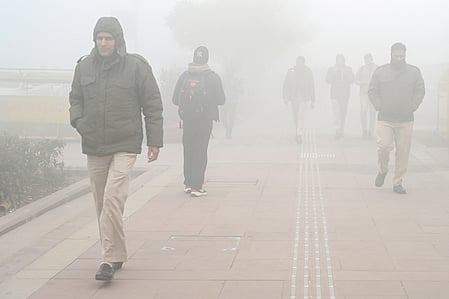
COLD wave and dense fog conditions are set to continue across northwestern, central, and eastern India in the coming days, the India Meteorological Department (IMD) said on Friday. The inclement weather has already disrupted transport, causing flight and train cancellations and delays.
According to the IMD, cold day conditions are expected in isolated areas of eastern Rajasthan and Bihar from 9-11 January, and in Punjab, Haryana, Chandigarh, western Rajasthan, and Madhya Pradesh on 9-10 January. Cold wave conditions may affect pockets across several states: Himachal Pradesh, Punjab, Haryana, Chandigarh, Odisha, and North Interior Karnataka on 10-11 January; Uttarakhand, Madhya Pradesh, Chhattisgarh, Jharkhand, and Bihar on 10 January; and Rajasthan from 11-14 January.
Dense fog is likely to persist during morning hours over northwest India and Bihar for the next 5-7 days, and over isolated parts of central India, northeast India, and Sub-Himalayan West Bengal and Sikkim over the next 2–3 days.
Minimum temperatures across north and central India remained low in the past 24 hours, reflecting the continuing grip of winter. As of 8:30 am on Friday, temperatures dipped below 0°C at many locations in Jammu–Kashmir–Ladakh–Gilgit–Baltistan–Muzaffarabad and isolated areas in Himachal Pradesh.
In Uttarakhand, Delhi, and northern Madhya Pradesh, minimum temperatures ranged from 0°C to 5°C, while many areas of Uttar Pradesh, Rajasthan, remaining parts of Madhya Pradesh, Bihar, West Bengal, and Sikkim recorded 5°C–10°C.
Similar conditions were reported at a few locations in Haryana and Madhya Maharashtra. Isolated pockets of Odisha, Assam, Meghalaya, Saurashtra and Kutch, Chhattisgarh, Jharkhand, and Telangana also recorded minimum temperatures between 5°C and 10°C. The lowest temperature in the plains was 3.4°C in Aligarh, Uttar Pradesh.
Despite the cold and fog, winter crops are unlikely to be affected. “Most rabi crops are currently in the growing stage, and with no reports of frost so far, the prevailing conditions are not expected to have any adverse impact on crops,” said D K Yadava, deputy director general (Crop Science), Indian Council of Agricultural Research (ICAR).
Rabi, or winter, crop sowing in 2025-26 has increased by more than 1.64 million hectares to 63.41 million hectares as of 2 January, according to the Ministry of Agriculture & Farmers’ Welfare. This represents a 2.65% rise from last year, and slightly below the season’s average coverage of 63.78 million hectares.
The growth in sown area was led by wheat, rice, pulses, and oilseeds. Wheat coverage rose by 613,000 hectares, rice by 267,000 hectares, and pulses by 344,000 hectares, with gram alone increasing by 466,000 hectares. Oilseeds, primarily rapeseed and mustard, expanded by 304,000 hectares to reach 9.63 million hectares.