


























































Thailand launches air raids along Cambodia border after deadly clashes
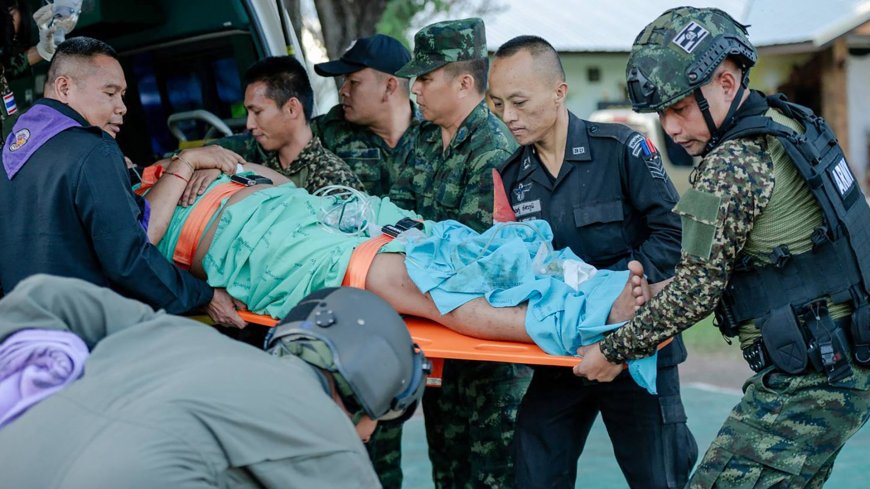
THAILAND'S military has launched air attacks along its disputed border with Cambodia as the Southeast Asian neighbours traded blame for clashes that killed one Thai soldier and wounded three Cambodian civilians, reports Al Jazeera.
In a statement on Monday, a spokesman for the Thai military, Major-General Winthai Suvari, said Thailand deployed the aircraft to “suppress” Cambodian attacks after the death of the Thai soldier in the Ubon Ratchathani province.
At least four others were also wounded in the incident, he said.
The Thai statement said the Cambodian soldiers had “fired small arms and curved weapons” from about 5:05 am (22:00 GMT on Sunday), with reports that one of its soldiers had been killed received at about 7 am (00:00 GMT)
Cambodia, however, disputed the Thai account.
The Cambodian military, in a statement on Facebook, said it was the Thai forces who had launched the first attack at 5 am local time on Monday. It added that the clashes followed “numerous provocative actions for many days” by Thai forces.
Later in the day, the deputy governor of the Cambodian border region of Oddar Meanchey said three civilians, including one woman, were wounded in Thai attacks.
Met Measpheakdey did not specify if the civilians were hurt by air strikes or gunfire.
The clashes came a day after another brief episode of fighting in the Phu Pha Lek–Phlan Hin Paet Kon area of Sisaket province, for which both sides blamed the other.
The Thai army said Cambodian fire injured two Thai soldiers and that Thai troops retaliated, resulting in an exchange of fire that lasted around 20 minutes.
Cambodia said that the Thai side fired first and that its own troops did not retaliate.
The attacks marked the latest outbreak of violence between the neighbours after a ceasefire that ended five days of deadly clashes in July. At least 48 people were killed during the hostilities, while an estimated 300,000 were displaced temporarily.
The ceasefire was brokered by Malaysian Prime Minister Anwar Ibrahim and United States President Donald Trump, who also witnessed the signing of an expanded peace agreement between the two countries in Kuala Lumpur in October.
Tensions have continued to flare, however.
Following a landmine blast last month that maimed one of its soldiers, Thailand said it was halting the implementation of the ceasefire pact with Cambodia. Phnom Penh denied responsibility for the landmine explosion, saying the device was a remnant from past conflicts.
Thai Prime Minister Anutin Charnvirakul said on Monday that his country did not want to see violence but the military was ready to take necessary measures to maintain security.
“Thailand has never wished for violence. I’d like to reiterate that Thailand has never initiated a fight or an invasion, but will never tolerate a violation of its sovereignty,” he said in a televised address.
For its part, Cambodia too said it did not want to be drawn back into direct conflict.
“Standing on the spirit of respecting all previous agreements and resolving conflicts peacefully according to international law, Cambodia did not retaliate at all during the two assaults and continues to monitor the situation vigilantly and with utmost caution,” the Cambodian military said.
Cambodia’s former Prime Minister Hun Sen also called for front-line Cambodian forces to be patient, accusing Thai forces of trying to “draw us into a fight to destroy the ceasefire and the Cambodia-Thailand peace declaration”.
He also urged athletes participating in the Southeast Asia Games, which are due to begin in Thailand on Tuesday, to “participate in the competition as normal”.
Thousands displaced
The clashes have resulted in renewed displacement in both countries.
Thailand’s Second Army Region said in a statement that about 35,000 people have been evacuated from areas along the border, while a spokesman for Cambodia’s Oddar Meanchey provincial administration said a “number of villagers who live near the border are fleeing to safety”.
The Cambodian province also suspended school on Monday over the fighting.
Anwar, the Malaysian prime minister, expressed deep concern.
“We urge both sides to exercise maximum restraint, maintain open channels of communication, and make full use of the mechanisms in place,” he said in a post on X.
“Malaysia stands ready to support steps that can help restore calm and avert further incidents. Our region cannot afford to see longstanding disputes slip into cycles of confrontation,” he added.
Thailand and Cambodia have for more than a century contested sovereignty at undemarcated points along their 817 km (508-mile) land border, first mapped in 1907 by France when it ruled Cambodia as a colony.
Simmering tension has occasionally exploded into skirmishes, such as a weeklong artillery exchange in 2011, despite attempts to peacefully resolve overlapping claims.