






















































































Assembly unanimously passes Vayojana Bill to protect senior citizens
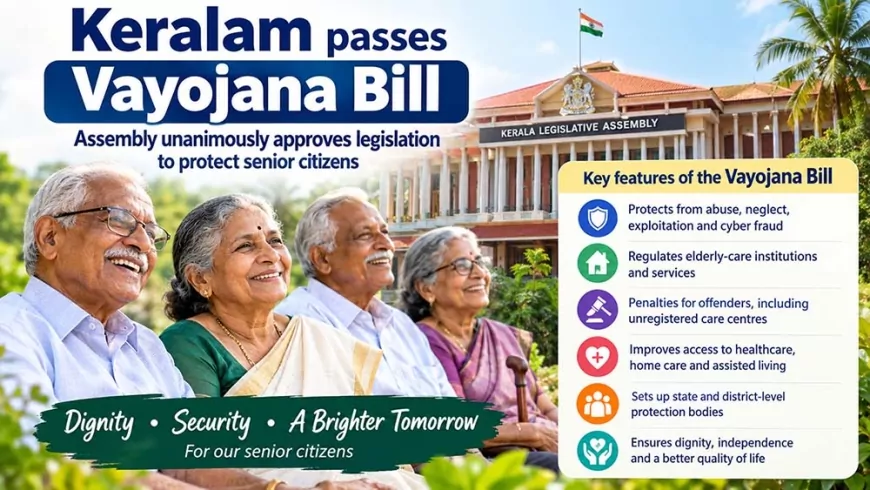
THE Keralam Legislative Assembly on Monday unanimously passed the Keralam Senior Citizens (Care and Protection of Rights) Bill, 2026, paving the way for a comprehensive legal framework to safeguard the rights, dignity and welfare of senior citizens.
The Bill seeks to protect older people from abuse, neglect, abandonment, financial exploitation and cyber fraud while regulating elderly-care institutions and services. It was passed after a detailed debate and the acceptance of several amendments proposed by members of both the ruling and opposition benches. The legislation will become law after receiving the Governor’s assent.
Stronger protection against abuse and exploitation
The proposed legislation provides for penalties against those who abuse or exploit senior citizens, illegally possess their property, abandon them or operate elderly-care centres without registration.
Cruelty against senior citizens can attract imprisonment of up to three years and a fine of up to Rs 50,000. Operating an unregistered care centre can invite imprisonment of up to one year, a fine of up to Rs 25,000, or both. The Bill also provides penalties for other specified violations.
Regulation of elderly-care institutions
The legislation envisages mandatory registration and regulation of senior citizen care centres, retirement homes, hospices, home-care agencies and caregiver-training centres. Prescribed standards are intended to ensure safe living conditions, proper care and protection from abuse.
It also proposes a structured training and certification system for caregivers, including background verification and police clearance for specified caregiving roles.
Dignity, healthcare and independent living
A central principle of the Bill is that older people should be able to remain in their own homes and communities for as long as possible, with appropriate support from family members, relatives or legal heirs.
The proposed framework seeks to improve access to affordable home care, day care, assisted living, emergency medical assistance and other essential services. It also emphasises accessible public spaces, legal aid, digital inclusion and reasonable access to essential assistive products such as hearing aids, spectacles and mobility aids.
Special protection and priority shelter provisions are envisaged for vulnerable older women.
New protection mechanisms
The Bill proposes state-level and district-level senior citizen protection bodies to handle complaints, inspect care facilities and coordinate responses to abuse and exploitation.
Registered medical practitioners and senior-care institutions will also be required to report suspected abuse, neglect or exploitation to the designated district-level authority within the prescribed period.
The legislation further provides for a State Reserve Fund to support senior citizens’ care, welfare, protection and social security. It also recognises living wills, enabling senior citizens to record their preferences regarding medical treatment towards the end of life, subject to the applicable prescribed procedures.
A response to Keralam’s ageing population
Keralam faces a growing need for comprehensive elderly-care services as its population ages. The new legislation seeks to move beyond conventional welfare measures by establishing a broader system of rights, institutional accountability and community-based support.
Chief Minister V. D. Satheesan described the legislation as a significant step towards guaranteeing the rights of senior citizens. The government’s stated objective is to develop a model that enables older people to live with dignity, security and independence.
With the Assembly’s unanimous approval, the Bill marks an important legislative step towards strengthening senior citizens’ protection in Keralam. Its practical impact will depend on the final legal process, the rules framed for implementation and the effectiveness of the proposed protection mechanisms.