















































































Bengaluru to ban two-wheelers, autos on 5 flyovers: Check date, timings and other details
The restrictions, announced on Sunday, will apply to five flyovers and elevated corridors, with separate rules for goods vehicles, autorickshaws and two-wheelers.

TRAFFIC restrictions for certain vehicles will come into effect on five flyovers in Bengaluru from September 4. The Bengaluru Traffic Police, in a statement, said the restrictions were being introduced to ease traffic movement, improve road safety and reduce fatal accidents.
The restrictions, announced on Sunday, will apply to five flyovers and elevated corridors, with separate rules for goods vehicles, autorickshaws and two-wheelers. The measures will initially be implemented on a trial basis, after which the traffic police will assess their impact and decide whether any further changes are required.
The restrictions will cover the BGS Flyover, Peenya Elevated Corridor, Electronics City Elevated Corridor, Double-Decker Flyover between Silk Board and Ragigudda, and the International Airport flyover stretch from Sanjeevnagar Cross to Vidyashilp Junction.
Explaining the rationale behind the restrictions, Karthik Reddy, Joint Commissioner of Police (Traffic), Bengaluru, told The Indian Express, “The key factors that were considered while taking decisions on restrictions were road safety, road design and width of the flyover, reducing the severity of the impact of accidents, mitigating traffic congestion caused by vehicle breakdowns, easing congestion occurring at the entry and exit points of flyovers, traffic management during emergencies, safety of pedestrians and two-wheeler riders and a comprehensive road safety approach.”
Electronics City corridor to face widest curbs
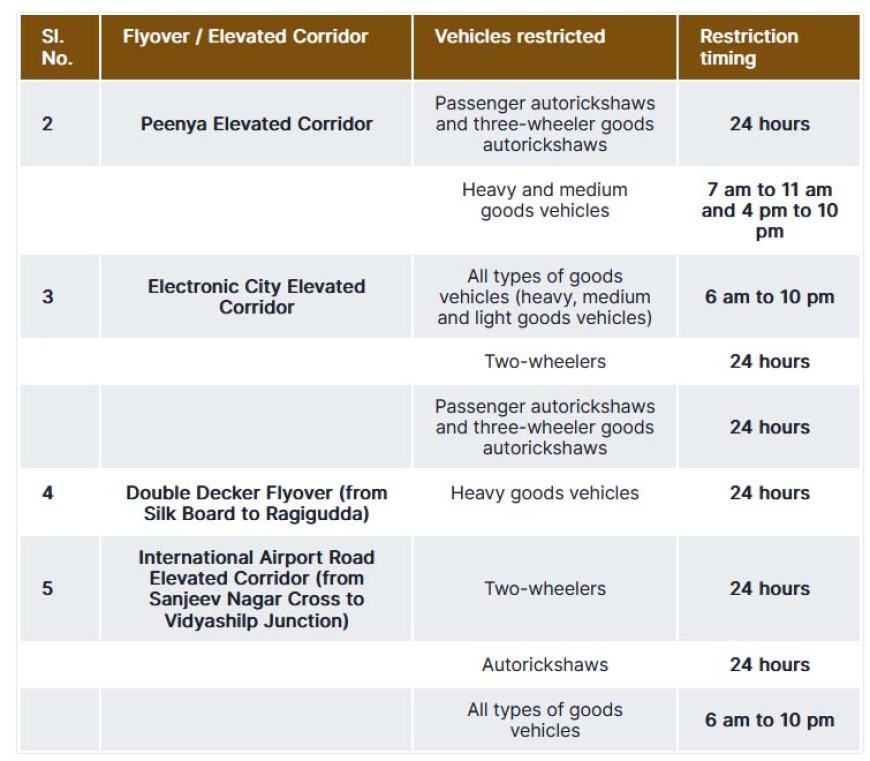
Among the five stretches, the Electronics City Elevated Corridor will see the most stringent restrictions. Heavy, medium and light goods vehicles will not be allowed on the corridor from 6 am to 10 pm. Two-wheelers, passenger autorickshaws and three-wheeler goods autorickshaws will face a round-the-clock ban.
Karthik Reddy said the Electronics City flyover had recorded more fatal accidents compared with the other flyovers, though the exact number of such incidents was not immediately available.
Airport corridor to prohibit two-wheelers, autorickshaws
The elevated stretch of the International Airport Road between Sanjeevnagar Cross and Vidyashilp Junction will also see significant restrictions. Two-wheelers and autorickshaws will be barred from the corridor throughout the day.
The movement of goods vehicles, irrespective of their category, will be restricted between 6 am and 10 pm. These curbs on the International Airport Road Elevated Corridor will be implemented from September 4.
Peenya flyover to see goods vehicle restrictions
Restrictions on the Peenya Elevated Corridor will also begin on September 4. The measures will include curbs on the movement of goods vehicles during specified hours.
Vehicle breakdowns a key factor behind restrictions
The traffic police said frequent vehicle breakdowns, particularly those involving goods vehicles, were among the major issues considered while framing the new restrictions.
“All flyovers witness breakdown of vehicles, especially goods-carrying vehicles. So, we have imposed these restrictions on a trial basis. Based on the results, we will take further decisions," Karthik was quoted as saying by Times of India.
Besides vehicle breakdowns, the traffic police assessed factors such as the design and width of individual flyovers, the potential severity of accidents, congestion around entry and exit points, emergency traffic management and the safety of pedestrians and two-wheeler riders.
The restrictions on the BGS Flyover, Peenya Elevated Corridor, Double-Decker Flyover and International Airport Road Elevated Corridor will be introduced from September 4. The curbs on the Electronics City Elevated Corridor will follow a week later, coming into force on September 11.