





























































Kerala: A land where humanity has many addresses
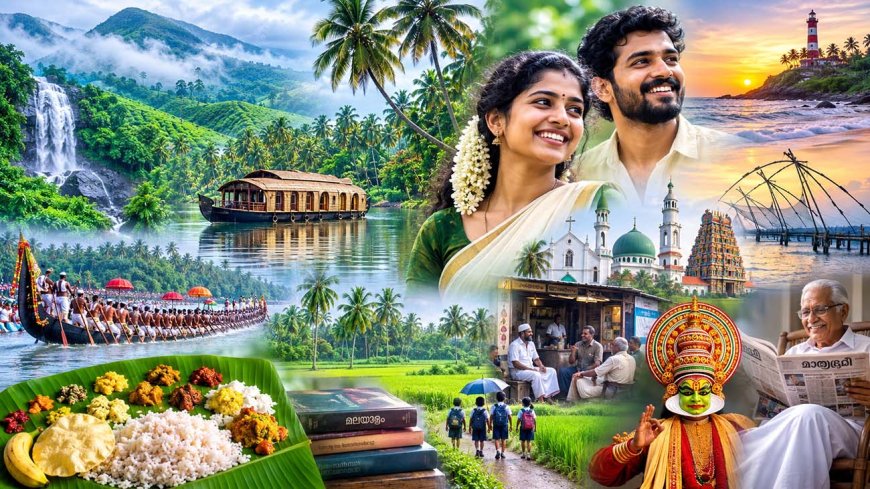
By Aseem Tiwari
I MAY be hopelessly biased, but I believe Kerala is the best place to live in India. There, the country seems to loosen its collar, lower its voice and breathe.
Rain in Kerala does not feel like weather. It feels like a member of the family who arrives without knocking, stays as long as it pleases and leaves its belongings everywhere.
On the roads, on the tiled roofs, inside the smell of coffee, between the pages of old books, upon the shoulders of coconut trees leaning over the backwaters to examine their own reflection. Green is not a colour there. Green is the climate, the wallpaper, the punctuation between one village and the next. Even the silence seems freshly washed.
The sea keeps turning up beside you, sometimes wild, sometimes exhausted, sometimes lying quietly beneath the evening as though it has finally said everything it came to say. The hills disappear into mist with the casual confidence of people who know they will be searched for. Rivers wander through towns without behaving like visitors. Banana leaves shine after the rain, ferries carry entire little worlds across the water, and every narrow road appears to know a secret way into paradise.
Yet Kerala’s deepest beauty is not something a camera can take home.
There are mornings when a temple bell, the azaan and a church bell travel through the same moist air and arrive together at a tea shop. Nobody looks up in confusion. Nobody asks the sky to choose. Tea continues to be poured, newspapers continue to be argued over, breakfast continues to disappear from steel plates. Nobody calls it harmony because nobody has arranged it for a photograph. It is simply life going about its business.
That, to me, is secularism.
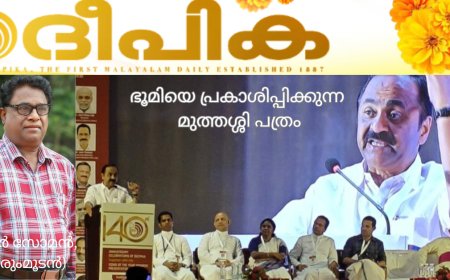
Not the word printed in large letters beneath a political speech, not the annual performance of public affection, not a carefully composed picture of three religious men smiling at a camera. It is the absence of surprise when different faiths share the same street. It is one neighbour knowing the date of another neighbour’s festival. It is food crossing doorways, children growing up among names their grandparents may not have carried, friendships in which gods are never asked to produce identity cards. Kerala does not keep secularism on its lips all day. It carries it somewhere in the bloodstream, where important things usually live.
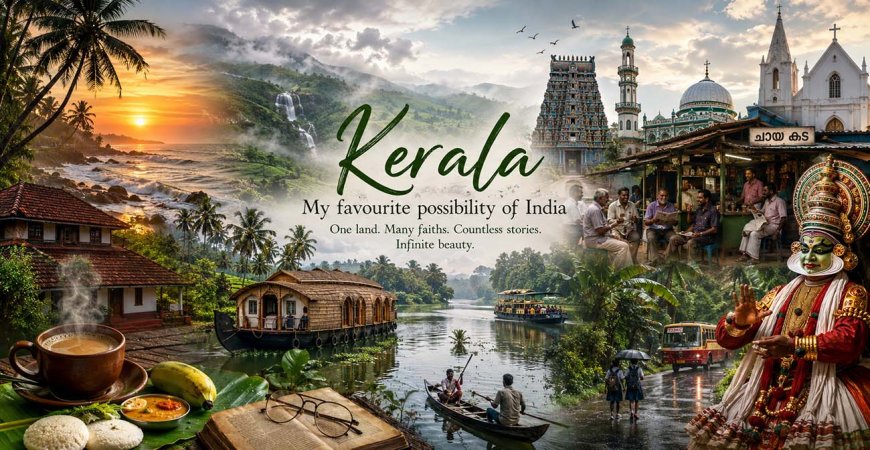
Perhaps this is why Kerala feels like more than a beautiful state to me. Beauty alone can make a place worth visiting; a certain generosity of spirit makes it worth belonging to. Kerala has that rare quality. It allows many versions of life to stand beside one another without demanding that one of them disappear.
And then there are Malayalis.
Honestly, it feels slightly unfair that one corner of the country should receive such extravagant portions of both beauty and intelligence. Mallus have faces that seem to have borrowed something from the rain, clear, composed, quietly luminous. But their beauty rarely arrives alone. It comes furnished with a library. There is thought behind the eyes, curiosity inside conversation, and an alertness that makes even casual talk feel alive. A conversation with a Malayali can travel from football to cinema, from literature to politics, from science to fish curry, and somehow reach every destination without losing its luggage.
They read. They question. They debate with the seriousness of Parliament and laugh with the timing of people who have understood the absurdity of Parliament. Their cinema trusts silence, their literature trusts the reader, their humour often arrives without ringing the doorbell, and their intelligence does not always feel the need to stand on a chair and announce itself. Even their disagreements appear better educated than most people’s certainties.
Of course, I am generalising. Affection always does. It remembers the sunlight and forgives the electricity bill. I know Kerala is a real place inhabited by real people, with its own contradictions, troubles and imperfections. I am not writing a government report. I am writing about the feeling a place leaves behind, and Kerala leaves behind something no souvenir shop can sell.
It leaves the feeling that India is still capable of tenderness.
It leaves rain in the mind, green behind the eyes, the taste of coconut and spice somewhere on the tongue, and a strange peace in the heart. It leaves the memory of a land where faith can have many addresses without humanity becoming homeless. It leaves you suspecting that heaven, if it exists at all, may not be floating above the clouds. It may be sitting beside a backwater in the evening, wearing a mundu, reading a newspaper and correcting your politics over a cup of tea.
This opinion is entirely mine. I have no survey to support it and no interest in defending it before a jury. Some feelings become smaller the moment they are forced to provide evidence. I only wanted to share mine because happiness, like Kerala rain, is rather poor at remaining contained.
Somewhere between its sea and its hills, its books and its backwaters, its many prayers and its shared mornings, Kerala has become my favourite possibility of India.
And Mallus, forgive my bias; remain my favourite evidence that nature occasionally shows off.