




























.jpg?#)





Modi govt moves to increase Lok Sabha seats from 543 to 850
The government is set to introduce in Parliament the Constitution (One Hundred and Thirty-First Amendment) Bill, 2026, on Thursday (April 14).

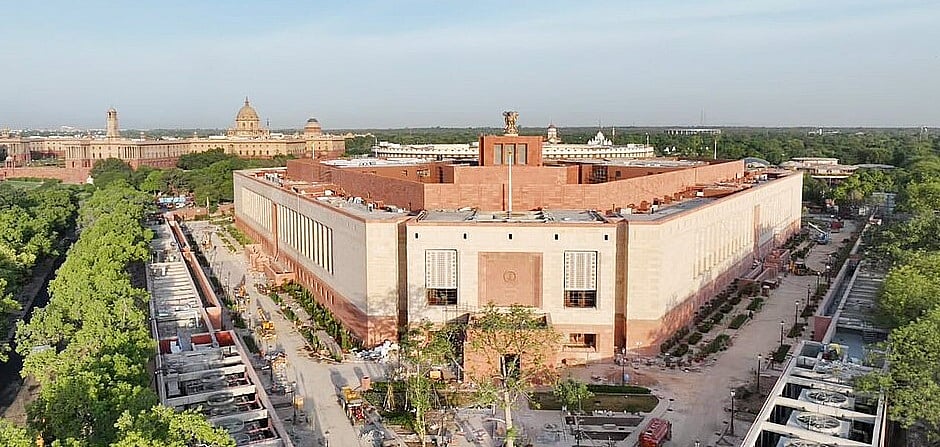
THE Centre has proposed increasing the strength of the Lok Sabha from the current 543 seats to up to 850 through a Constitutional Amendment Bill, linking the move to a future delimitation exercise based on updated census data.
The Constitution (One Hundred and Thirty-first Amendment) Bill, 2026, introduced in the Lok Sabha, seeks to revise provisions governing the composition of the House of the People and the allocation of seats across states and union territories (UTs).
What does the Bill propose on Lok Sabha composition?
The Lok Sabha currently has 543 elected members. The Bill proposes to amend Article 81 (Composition of the House of the People) to allow for not more than 815 members from states and up to 35 from Union Territories, taking the total strength to 850.
How is the proposal linked to delimitation and census data?
The proposed changes are tied to a fresh delimitation exercise. Amendments to Article 82 (Readjustment after each census) and Article 170 (Composition of the Legislative Assemblies) replace earlier wording linked to “completion of each census” with a clearer framework, stating that allocation of seats will be carried out “in such manner and on the basis of such census, by the Delimitation Commission.”
How does the Bill define ‘population’?
The Bill also standardises the definition of 'population' across provisions. It states:
“In this article, the expression ‘population’ means the population as ascertained at such census, as Parliament may by law determine, of which the relevant figures have been published.”
What changes are proposed for SC/ST reservation?
According to the proposed Bill, changes have also been proposed to Article 332 (Reservation of seats for the Scheduled Castes and the Scheduled Tribes in the Legislative Assemblies of the States), with specific provisions relating to Scheduled Tribes in certain northeastern states.
The revised clauses provide that reservation should reflect proportional representation, stating that seats “shall be such number of seats as bears to the total number of seats, a proportion not less than the number of members belonging to the Scheduled Tribes.”
What does the Bill say about women’s reservation?
Another key clause of the Bill is the insertion of Article 334A (Reservation of seats for women), which introduces reservation for women in the Lok Sabha and state assemblies. However, the provision makes clear that it will not take effect immediately, stating that it will come into force “after an exercise of delimitation is undertaken for this purpose.”
The Bill further provides that such reservation will operate for 15 years, unless extended by Parliament, and that: “The seats reserved for women… shall be allotted by rotation to different constituencies in a State or Union territory.”
Will existing legislatures be affected immediately?
It also clarifies that existing legislatures will not be impacted immediately, noting that representation will continue until “the dissolution of the then existing House of the People or the Legislative Assembly… after the exercise of delimitation is undertaken.”
The proposed changes are anchored to Census 2027, as the Bill repeatedly links seat allocation and delimitation to updated population data. It standardises the definition of “population” across provisions, stating: “In this article, the expression ‘population’ means the population as ascertained at such census, as Parliament may by law determine, of which the relevant figures have been published.”
The next census is expected to be conducted in phases, with house listing likely to begin in 2026, followed by population enumeration. It is set to be India’s first fully digital Census, with data collection carried out in two phases and expected to enable faster processing of results.