

































































11 India-bound vessels carrying oil, LPG successfully cross Strait Of Hormuz after Iran-US deal , says Govt
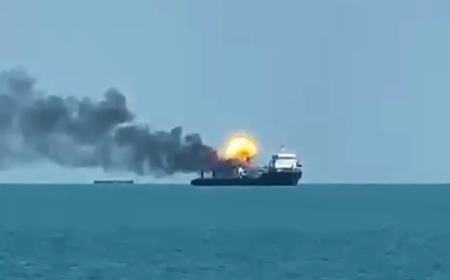
11 India-bound vessels, including crude oil tankers, an LPG carrier and bulk carriers carrying fertilisers, have successfully transited through the Strait of Hormuz since the US and Iran signed a Memorandum of Understanding aimed at ending the West Asia conflict.

ELEVEN India-bound vessels have crossed the Strait of Hormuz since the United States and Iran finalised a Memorandum of Understanding (MoU) aimed at ending the conflict in West Asia, the Ministry of External Affairs (MEA) said on Tuesday.
Speaking at a media briefing, MEA spokesperson Randhir Jaiswal said the movement of ships through one of the world's most strategically important maritime routes has continued following the agreement signed on June 17.
"As of today, we have 10 Indian-flagged vessels which are still in the Persian Gulf region. In addition, two have recently arrived there," he said.
Providing an update on shipping traffic, Mr Jaiswal added, "Since the signing of the MoU on June 17, 11 India-bound vessels have transited through the Strait of Hormuz."
According to the MEA, the vessels that successfully crossed the strait include three Indian-flagged crude oil tankers, each carrying more than 285,000 metric tonnes of crude oil.
The list also includes one foreign-flagged LPG carrier, one foreign-flagged crude oil tanker and six foreign-flagged bulk carriers transporting fertiliser cargo.
"We hope that the remaining India-flagged vessels would also be able to cross the Hormuz soon," Mr Jaiswal said.
The Strait of Hormuz is considered one of the world's most critical energy corridors, linking the Persian Gulf with global shipping routes and facilitating the transport of crude oil and other commodities.
India-UAE Defence Partnership Has Seen 'Major Upswing'
During the briefing, the MEA also spoke about India's defence ties with the United Arab Emirates.
On India-UAE defence cooperation, Mr Jaiswal said, "This is a very important relationship with the United Arab Emirates, which in recent years has actually seen a major upswing, and in that upswing the defence partnership also plays an important role, and that also has strengthened and deepened, so that is where we are in our defence partnership".
The MEA also addressed reports concerning incidents involving Hindu religious symbols in Bangladesh.
"We have seen reports from Bangladesh regarding acts of desecration involving Hindu deities and their images, which have sparked protests. We expect the Bangladeshi government to curb the extremists there and guarantee the safety of the minority community," Mr Jaiswal said.
NSA Ajit Doval, Chinese Foreign Minister Discuss Bilateral Ties
Responding to questions about the meeting between National Security Advisor Ajit Doval and Chinese Foreign Minister Wang Yi, the MEA spokesperson said the two sides reviewed recent developments in bilateral relations.
"There was a meeting yesterday between the National Security Advisor and Chinese Foreign Minister Wang Yi, the two sides reviewed recent developments in bilateral relations and noted progress towards gradual normalisation in ties. National Security Advisor underlined that stable, predictable, and constructive bilateral relations contribute to building trust and a better understanding between the two sides. These discussions were forward-looking and constructive," Mr Jaiswal said.
Mr Jaiswal said, "...Yesterday, National Security Advisor had bilateral meetings with several of his counterparts, including from Iran, Ethiopia, Brazil, China and South Africa. Today, they have had the BRICS NSA meeting, where the agenda, as we had informed you earlier, is how the BRICS countries together deal with non-traditional security challenges that the world confronts. They would discuss the evolving nature of national security challenges and the role of new technologies in the emerging security threats...The review of the outcomes of the recently held BRICS joint working groups on counterterrorism and security in the use of information and communication technologies was also to be reviewed at this particular meeting."
The briefing covered a range of regional and global developments, including maritime trade, bilateral ties, security cooperation and concerns relating to minority communities in the neighbourhood.