





























































‘Prison-like, if not worse’: HC on Thrissur mental health centre’s ‘cells’
Follow TNM's WhatsApp channel for news updates and story links.The conditions of the government Mental Health Centre in Thrissur are “shocking and dehumanising”, a bench of the Kerala High Court noted after a personal inspection of the facility. “Words fail us when we try to describe the situation and conditions of the centres in question. They belong to at least a century past and not to the modern times,” the division bench comprising Justices Devan Ramachandran and Basant Balaji wrote in an order directing the state government to file a detailed affidavit on the corrective measures taken by August 18.The same bench had inspected the Mental Health Centre in Thiruvananthapuram a few days earlier and issued separate directions on July 21.The judges spent over three-and-a-half hours inspecting the 14-acre Thrissur campus on July 26. The court said the condition of the campus showed years of neglect. It observed, “The front elevation, gate, and name boards are in a totally unkept manner, with paint having pealed, algae having grown all over, tall shrubs having captured most of it – the perfect setting for a scene from a horror movie.”‘Prison-like cells’The court was particularly critical of the isolation and confinement areas referred to as ‘cells’. These small, segregated spaces were found to be worse in the women’s wards than in the men’s wards.The court noted, “The 'cells' were prison-like, if not worse, with iron grills, tiny, dark, and poorly ventilated cage-like structures. The design of the cells are unmistakably colonial and belong to centuries past, with the atmosphere in them being turbid, soiled, and revolting.”The judges said many patients kept in these spaces appeared to be in distress. They noted, “The patients who are in the segregation/isolation facilities called 'cells', were mostly exhibiting signs of deep fear and panic, most of them with loss of touch with reality; and we were told by the doctors that many of them were also prone to self-harm, including suicide.”The court said it was not medically qualified to decide whether segregation was clinically necessary and left that decision to doctors. However, it said such spaces must be suitable for human habitation and patients must be “given accommodation fit for humans.”Staff shortage across the boardThe court also found a serious staff shortage at the centre. The vacancies include nurses, nursing assistants, attenders, security personnel, and doctors, including psychiatrists. The court was also told that posts such as cooks and washer-staff had been abolished altogether.The bench recorded the difficulties faced by the existing staff. On transporting food, it observed, “They are forced to use a hand-drawn cart, the wheels of which are already dodgy and loose, on which heavy vessels carrying food sit very perilously.”The court also raised concerns about the lack of security infrastructure.A young psychiatrist told the bench that police assistance was unreliable, especially at night. The court noted that the police aid post at the centre “caters only to the outpatient department” and functions only until the afternoon.The court therefore called for the police aid post to function round the clock.Unused buildings, overcrowded wardsThe court found that some usable buildings at the centre are lying vacant even though existing wards are overcrowded.It identified at least three buildings that could be restored and used. One of them is a former COVID-19 isolation ward. The building cannot currently be used because an electric transformer in the premises does not have the fencing required to safely use it.The bench observed, “There is no fencing around the transformer and hence that energisation is not possible. A classic case where a horse is lost, for want of a shoe!”Another building, said to be the former ward number 1, has been declared unfit by the Public Works Department because of a lack of routine maintenance.The judges criticised the delay in repairing and using the buildings. They wrote, “We have little doubt that, in any other scenario, such buildings would have been immediately repaired and put to use; but, in the case of these poor and hapless patients, we saw that the response is pachydermic and so slow, that snails would be put to shame.”The court also noted an unfinished five-storey building intended to be used as the Modern Male Psychiatric Ward. No official could allegedly explain the reason for the delay or provide clarity on its current construction status.Other safety concernsParvathy Menon, coordinator of the Victim Rights Centre (VRC) under the Kerala State Legal Services Authority (KeLSA), told the court that she had visited the facility a week earlier and had found snakes and stray dogs moving freely around the campus. The court referred to an incident in which a snake was found in the Out Patient Department. It recorded, “In the Out Patient Department, a snake was found hanging from its roof, which fell on one of the doctors
Follow TNM's WhatsApp channel for news updates and story links.
THE conditions of the government Mental Health Centre in Thrissur are “shocking and dehumanising”, a bench of the Kerala High Court noted after a personal inspection of the facility.
“Words fail us when we try to describe the situation and conditions of the centres in question. They belong to at least a century past and not to the modern times,” the division bench comprising Justices Devan Ramachandran and Basant Balaji wrote in an order directing the state government to file a detailed affidavit on the corrective measures taken by August 18.
The same bench had inspected the Mental Health Centre in Thiruvananthapuram a few days earlier and issued separate directions on July 21.
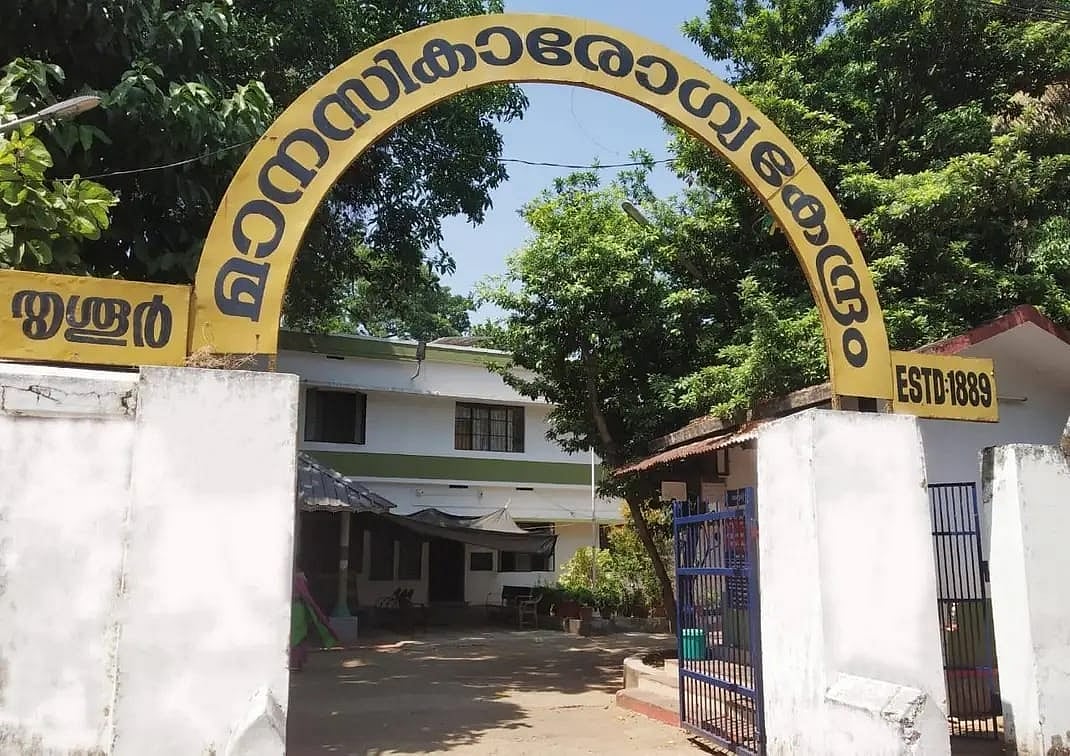
The judges spent over three-and-a-half hours inspecting the 14-acre Thrissur campus on July 26. The court said the condition of the campus showed years of neglect.
It observed, “The front elevation, gate, and name boards are in a totally unkept manner, with paint having pealed, algae having grown all over, tall shrubs having captured most of it – the perfect setting for a scene from a horror movie.”
‘Prison-like cells’
The court was particularly critical of the isolation and confinement areas referred to as ‘cells’. These small, segregated spaces were found to be worse in the women’s wards than in the men’s wards.
The court noted, “The 'cells' were prison-like, if not worse, with iron grills, tiny, dark, and poorly ventilated cage-like structures. The design of the cells are unmistakably colonial and belong to centuries past, with the atmosphere in them being turbid, soiled, and revolting.”
The judges said many patients kept in these spaces appeared to be in distress. They noted, “The patients who are in the segregation/isolation facilities called 'cells', were mostly exhibiting signs of deep fear and panic, most of them with loss of touch with reality; and we were told by the doctors that many of them were also prone to self-harm, including suicide.”
The court said it was not medically qualified to decide whether segregation was clinically necessary and left that decision to doctors. However, it said such spaces must be suitable for human habitation and patients must be “given accommodation fit for humans.”
Staff shortage across the board
The court also found a serious staff shortage at the centre. The vacancies include nurses, nursing assistants, attenders, security personnel, and doctors, including psychiatrists. The court was also told that posts such as cooks and washer-staff had been abolished altogether.
The bench recorded the difficulties faced by the existing staff. On transporting food, it observed, “They are forced to use a hand-drawn cart, the wheels of which are already dodgy and loose, on which heavy vessels carrying food sit very perilously.”
The court also raised concerns about the lack of security infrastructure.
A young psychiatrist told the bench that police assistance was unreliable, especially at night. The court noted that the police aid post at the centre “caters only to the outpatient department” and functions only until the afternoon.
The court therefore called for the police aid post to function round the clock.
Unused buildings, overcrowded wards
The court found that some usable buildings at the centre are lying vacant even though existing wards are overcrowded.
It identified at least three buildings that could be restored and used. One of them is a former COVID-19 isolation ward. The building cannot currently be used because an electric transformer in the premises does not have the fencing required to safely use it.
The bench observed, “There is no fencing around the transformer and hence that energisation is not possible. A classic case where a horse is lost, for want of a shoe!”
Another building, said to be the former ward number 1, has been declared unfit by the Public Works Department because of a lack of routine maintenance.
The judges criticised the delay in repairing and using the buildings. They wrote, “We have little doubt that, in any other scenario, such buildings would have been immediately repaired and put to use; but, in the case of these poor and hapless patients, we saw that the response is pachydermic and so slow, that snails would be put to shame.”
The court also noted an unfinished five-storey building intended to be used as the Modern Male Psychiatric Ward. No official could allegedly explain the reason for the delay or provide clarity on its current construction status.
Other safety concerns
Parvathy Menon, coordinator of the Victim Rights Centre (VRC) under the Kerala State Legal Services Authority (KeLSA), told the court that she had visited the facility a week earlier and had found snakes and stray dogs moving freely around the campus.
The court referred to an incident in which a snake was found in the Out Patient Department. It recorded, “In the Out Patient Department, a snake was found hanging from its roof, which fell on one of the doctors and it was only because of providence that nobody was harmed.” Nets have been installed around several wards to prevent snakes from entering.
Doctors also told the bench that the centre does not have adequate lighting at night. Staff have to use torches or mobile phone flashlights while moving between wards after dark.
The court further found that the main entrance is too narrow for a fire engine to enter. An alternative route passes through an active construction site. The judges said this route “would have no purpose, should there be a real fire incident.”
Court praises frontline staff
Despite its criticism of the facility, the bench praised the medical and support staff working there.
The court noted that many patients had developed close bonds with the staff. Recalling an incident during the inspection, the judges wrote, “We found them to be very devoted, committed, and engaged to what they are assigned to, with many patients showing deep attachment towards them, as in the case of a young lady we saw in one of the 'cells', calling out to a security guard by her name, adding the suffix 'chechi' (sister).”
The court also praised the centre’s Occupational Therapy unit.
Patients at the unit make candles, umbrellas, and soaps. The court said those participating in the activities appeared “almost in a recovered state” compared with patients confined to the cells.
Court’s directions
The bench recorded several assurances given during the inspection.
The Secretary of the Health Department, who participated online, said repairs to the main wall and gate of the Thrissur centre had already been ordered. However, widening the entrance to allow fire engines to enter would take more time.
The Thrissur District Police Chief, who was present during the inspection, assured the court that a police beat would function round the clock at the centre. A control room vehicle would also be stationed nearby at night.
The police chief also agreed to provide the centre’s Superintendent with the direct contact numbers of nearby police officers.
The court directed competent authorities to file a detailed affidavit addressing every concern raised in the order regarding the Thrissur centre. The affidavit must also detail the remedial measures taken and be filed before August 18.
The deadline for the Thiruvananthapuram Mental Health Centre had been set as July 21.
The bench said it would also inspect the Mental Health Centre in Kozhikode.
Financial constraints cannot be used as a reason for failing to ensure basic rights, the judges stated.
They wrote, “No excuses, including financial, can come in the way of ensuring that basic human rights are ensured; and this is the most rudimentary desideratum of any working democracy like ours, which is guided by the most powerful and meticulous constitutions in the world.”
The case will next be considered after the government files its affidavit.