






































































.jpg?#)






Marine heatwaves in Arabian Sea are threatening fish stocks, fisherfolk in Kerala
Follow TNM's WhatsApp channel for news updates and story links. For fisherfolk along Kerala’s coast, the sea is no longer behaving as it once did. Increasing sea surface temperatures (SST) and frequent marine heatwaves in the Arabian Sea are beginning to disrupt both marine ecosystems and fishing livelihoods. As global temperatures rise, these impacts are not confined to the ocean alone, but are expected to spill over onto land as well. On April 20, the Marine Heatwave Advisory Services (MAHAS) bulletin reported that 22%, 9%, and 1% of the Arabian Sea fall under “Watch,” “Alert,” and “Warning” categories, respectively, denoting moderate, high, and extreme risk. A “warning” indicates a sustained period of above-average temperatures, posing serious threats to marine ecosystems. Vinod PG, general manager (GIS division) at Prime Technology and a collaborator with the Centre for Advanced Atmospheric Research, explained that marine heatwaves are periods when sea surface temperatures (SST) remain abnormally high. The Indian Marine Heat Wave Advisory has warned that such conditions could lead to coral reef stress, shifts in pelagic fisheries, and a reduction in marine productivity. “Work is generally less during the summer… the fish are not staying in the sea,” said Sreejith PP, a 40-year-old fisherman from Madakkara Fishing Harbour in Kasaragod. “The fish are all in the northern sea now, we only get catches when they come from there little by little,” he added. Rafiq Mohammed, 48, the boatswain of their trawling boat, pointed to rising sea surface heat as a key factor. Fishes such as sardines and mackerel (pelagic species) are moving deeper and towards cooler northern waters. “While these are hard months to get fish in, we were able to get some this year. These catches are very rare.” While these fish typically return when conditions stabilise, climate change is disrupting long-established migration patterns. In his study ‘Fish Migration Patterns in a Changing Climate: An Overview from an Indian Perspective’, scholar SK Anand writes that “changes are being observed in the timing, routes, and success of fish migration in both freshwater and marine ecosystems.” The study outlines the broader implications for fish production, aquatic biodiversity, and fishing-dependent livelihoods. Sreejith noted that February was relatively manageable, but conditions have worsened with the onset of summer. “It is difficult even for us to stay at sea,” he said. “Usually the breeze is nice, but now we are not able to stay on sea also.” Vinod explained that global warming is the primary driver of rising SST. Factors such as direct solar heating and reduced oxygen mixing contribute to this. Warmer water holds less dissolved oxygen, and as surface temperatures rise, oxygen solubility decreases. This leads to stratification, where warmer, buoyant surface water fails to mix with cooler, deeper layers, further intensifying surface heating. The impacts are not limited to the sea. Higher SST also causes thermal expansion of seawater, contributing to coastal erosion, Vinod said. According to the International Fund for Animal Welfare (IFAW), climate change has increased the frequency of marine heatwaves, which can also raise ocean acidity. Together, these changes can lead to mass mortality events in marine life. Coral reefs and phytoplankton, both highly sensitive to temperature changes, are particularly vulnerable. Since marine food chains depend heavily on these, disruptions can cascade across ecosystems, ultimately affecting human communities as well. Along Kerala’s coast, phytoplankton serve as primary producers. “Phytoplanktons are the primary producers and actually they will survive in nutrient-rich waters,” noted Dr Amruth P, marine biologist and assistant professor in the Department of Life Science at Christ University, Bengaluru. However, rising temperatures reduce nutrient solubility, which can “affect its distribution and diversity basically,” he said. “Everything is connected,” Dr Amruth added. “Phytoplanktons are fed on by small fishes, which again are fed by large fishes. So the fish distribution, richness, everything is affected.” In the study ‘Phytoplankton: The Microscopic Powerhouses of the Ocean’, published in the Journal of Oceanography and Marine Research, Edoardo Casoli notes that disruptions in phytoplankton growth can collapse food webs and significantly impact oxygen production. The Copernicus Climate Change Service reported that March 2026 recorded the second-highest global SST on record, and suggested a possible shift towards El Nino conditions. However, as of March 26, the Central Marine Fisheries Research Institute (CMFRI) reported no overall decline in Kerala’s marine fish production despite periodic fluctuations, according to Fisheries, Animal Husbandry and Dairying Minister Rajiv Ranjan Singh. For fishermen like Rafiq and Sreejith, hope now rests on the monsoon. A week of rain can bring fish back closer to the su
Follow TNM's WhatsApp channel for news updates and story links.
FOR fisherfolk along Kerala’s coast, the sea is no longer behaving as it once did.
Increasing sea surface temperatures (SST) and frequent marine heatwaves in the Arabian Sea are beginning to disrupt both marine ecosystems and fishing livelihoods. As global temperatures rise, these impacts are not confined to the ocean alone, but are expected to spill over onto land as well.
On April 20, the Marine Heatwave Advisory Services (MAHAS) bulletin reported that 22%, 9%, and 1% of the Arabian Sea fall under “Watch,” “Alert,” and “Warning” categories, respectively, denoting moderate, high, and extreme risk. A “warning” indicates a sustained period of above-average temperatures, posing serious threats to marine ecosystems.
Vinod PG, general manager (GIS division) at Prime Technology and a collaborator with the Centre for Advanced Atmospheric Research, explained that marine heatwaves are periods when sea surface temperatures (SST) remain abnormally high.
The Indian Marine Heat Wave Advisory has warned that such conditions could lead to coral reef stress, shifts in pelagic fisheries, and a reduction in marine productivity.
“Work is generally less during the summer… the fish are not staying in the sea,” said Sreejith PP, a 40-year-old fisherman from Madakkara Fishing Harbour in Kasaragod. “The fish are all in the northern sea now, we only get catches when they come from there little by little,” he added.
Rafiq Mohammed, 48, the boatswain of their trawling boat, pointed to rising sea surface heat as a key factor. Fishes such as sardines and mackerel (pelagic species) are moving deeper and towards cooler northern waters. “While these are hard months to get fish in, we were able to get some this year. These catches are very rare.”
While these fish typically return when conditions stabilise, climate change is disrupting long-established migration patterns. In his study ‘Fish Migration Patterns in a Changing Climate: An Overview from an Indian Perspective’, scholar SK Anand writes that “changes are being observed in the timing, routes, and success of fish migration in both freshwater and marine ecosystems.”
The study outlines the broader implications for fish production, aquatic biodiversity, and fishing-dependent livelihoods.
Sreejith noted that February was relatively manageable, but conditions have worsened with the onset of summer. “It is difficult even for us to stay at sea,” he said. “Usually the breeze is nice, but now we are not able to stay on the sea also.”
Vinod explained that global warming is the primary driver of rising SST. Factors such as direct solar heating and reduced oxygen mixing contribute to this.
Warmer water holds less dissolved oxygen, and as surface temperatures rise, oxygen solubility decreases. This leads to stratification, where warmer, buoyant surface water fails to mix with cooler, deeper layers, further intensifying surface heating.
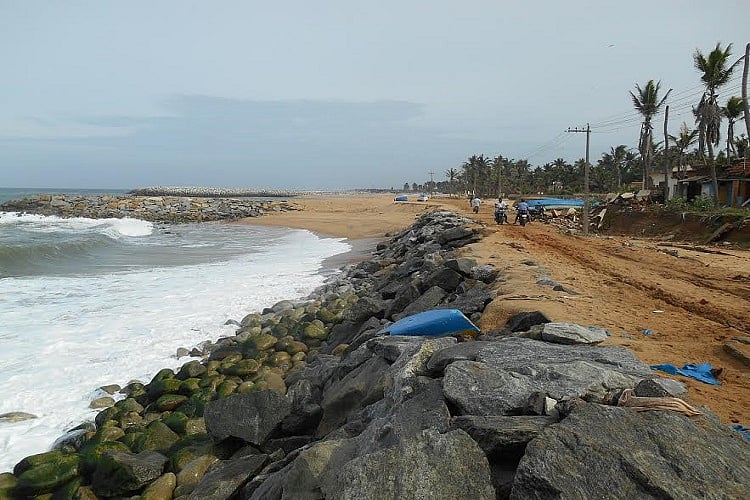
The impacts are not limited to the sea. Higher SST also causes thermal expansion of seawater, contributing to coastal erosion, Vinod said.
According to the International Fund for Animal Welfare (IFAW), climate change has increased the frequency of marine heatwaves, which can also raise ocean acidity. Together, these changes can lead to mass mortality events in marine life.
Coral reefs and phytoplankton, both highly sensitive to temperature changes, are particularly vulnerable. Since marine food chains depend heavily on these, disruptions can cascade across ecosystems, ultimately affecting human communities as well.
Along Kerala’s coast, phytoplankton serve as primary producers. “Phytoplanktons are the primary producers and actually they will survive in nutrient-rich waters,” noted Dr Amruth P, marine biologist and assistant professor in the Department of Life Science at Christ University, Bengaluru. However, rising temperatures reduce nutrient solubility, which can “affect its distribution and diversity basically,” he said.
“Everything is connected,” Dr Amruth added. “Phytoplanktons are fed on by small fishes, which again are fed by large fishes. So the fish distribution, richness, everything is affected.”
In the study ‘Phytoplankton: The Microscopic Powerhouses of the Ocean’, published in the Journal of Oceanography and Marine Research, Edoardo Casoli notes that disruptions in phytoplankton growth can collapse food webs and significantly impact oxygen production.
The Copernicus Climate Change Service reported that March 2026 recorded the second-highest global SST on record, and suggested a possible shift towards El Nino conditions. However, as of March 26, the Central Marine Fisheries Research Institute (CMFRI) reported no overall decline in Kerala’s marine fish production despite periodic fluctuations, according to Fisheries, Animal Husbandry and Dairying Minister Rajiv Ranjan Singh.
For fishermen like Rafiq and Sreejith, hope now rests on the monsoon. A week of rain can bring fish back closer to the surface, they said. But the season also brings its own risks. “We can’t work when the wind and things come, then we’ll have to stop,” Rafiq said.
Vinod further noted that Kerala’s long coastline makes it both dependent on, and exploitative of, marine resources. While livelihoods and food culture are deeply tied to the sea, coastal pollution has further strained already vulnerable ecosystems.
This article was written by a student interning with TNM.