













































































Sabarimala: Up to Rs 5,000 fine for discarding clothes, waste in Pamba river
The Sabarimala season is here, drawing lakhs of devotees to Sabarimala this month, the Pampa River is once again drowning in non-biodegradable garbage at the Pampa and Triveni bathing ghats. Despite multi-language warning boards put up by the government, thousands of pilgrims are ignoring the rules and dumping synthetic clothes, plastic wrappers, and used tissues straight into the water under the guise of Vastra Danam. Vastra Danam is a ritual followed by pilgrims in which devotees abandon their worn clothes in the river, believing it washes away their past sins. The Travancore Devaswom Board assigned Clean Kerala Company Ltd (CKCL) and 30 sanitation workers; however, persistent delays in clearing the ghats have resulted in wet piles of nylon and polyester choking the riverbed. What starts out every morning as a customary dip before the forest walk swiftly devolves into a dense tangle of floating trash and abandoned clothing.As footfall climbs higher each day of the current season, the gap between pilgrim numbers and waste collection is leaving the river basin visibly suffocated. Unless enforcement tightens on the ground right now, the holy waters meant to cleanse devotees will remain buried under their own waste.Clothes all thrown overboard are reduced to a heap; the used tissues, plastics, and bits of floating debris all turn stark. What was initially an act of ritual cleansing is going to turn messy very quickly along this belt of forest.When the community attempts to explain the mess or minimize the impact on the environment, critical voices are the first to take issue with how the issue is being defined. "Any other denotation of that word is just the projection of your classist and racist perspective," said Aaron Philp, journalist. He referred to efforts to dismiss the damage and lessen the real price the river and community paid.The rituals at the riverbankThe most abominable practice along the banks is Vastra Danam where people abandon their used clothes in the water. The misconception of abandoning clothes (Vastra Danam) in the Pampa gained momentum in the late 1990s and early 2000s among pilgrims that throwing away your clothes after a dip helps you throw away bad luck, sick health, and old sins.The locals note that the river used to have a certain fragrance in the mornings when the faithful would take a dip in the river. The banks have been littered with the detritus of devotion; black, blue, and saffron clothes are hung and lodged in the riverbanks. The environmentalists note that the millions of pilgrims using the river for ritualistic cleansing are committing an ecological crime against the land. The Pamba's ebbing flow, a seasonal diminution that leaves the river gasping for breath, has led to a near-complete depletion of species that thrive on the banks.On top of the clothes, millions of people bathing together wash tons of cheap soap, shampoo, and hair oil straight into the water. Add plastic wrappers, coconut husks, and puja materials to the mix, and the river ecosystem basically collapses every single winter.Local communities bear the aftermathOnce the season ends and millions go back home, people living down the river basin are left holding the bag. For local families, what should be their main water source turns into a health hazard, year after year."Besides its sacred importance, the Pampa River's geographical location is inextricably linked to the local culture. Conservation efforts should be made with an eye toward proper waste disposal and sustainable practices," said Pramod Narayan, former Ranni MLAThe biggest breakdown happens in basic toilet facilities when the heavy crowd rushes in. "Inadequate sanitation facilities for Sabarimala pilgrims is one of the primary reasons for the river getting polluted. Provision of basic amenities must be made available at four different spots with scientific waste management systems," said Sinu VS, a resident.When public toilets and 'temporary' latrines are blocked and overflowing, people are forced to defecate, and waste pits spill over. Rains then carry that untreated poo into open water sources, which the residents of those communities use for drinking and cooking every single day.Below Kuttanad, the septic waste is left as a stagnant pool in the network of canals. Residents suffer skin irritation, diarrhoea, and jaundice for weeks immediately after the pilgrimage ends, giving evidence of the reach of the ritual footprint.Scientific studies reveal ecosystem collapseWater contamination during pilgrimage months can be seen clearly from studies carried out by the Kerala State Pollution Control Board and independent water scientists:Dissolved Oxygen (DO) levels Dip: River water fresh from the hills contains DO levels around 6.5 mg/L, but on Triveni's heaviest bathing days, DO dives below 3.0 mg/L, leaving the water so desolate that fish can no longer live there.Biochemical Oxygen Demand (BOD) Explodes: You will see this with hundreds of tons of dec
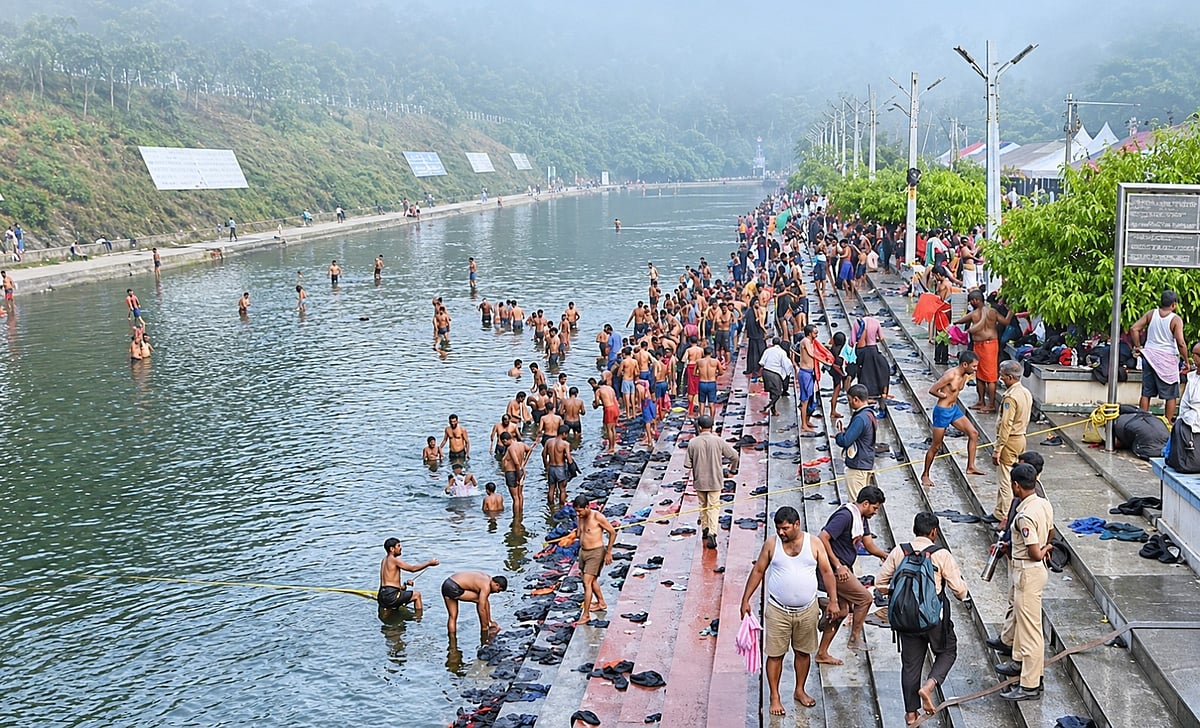
THE Sabarimala season is here, drawing lakhs of devotees to Sabarimala this month; the Pampa River is once again drowning in non-biodegradable garbage at the Pampa and Triveni bathing ghats.
Despite multi-language warning boards put up by the government, thousands of pilgrims are ignoring the rules and dumping synthetic clothes, plastic wrappers, and used tissues straight into the water under the guise of Vastra Danam. Vastra Danam is a ritual in which pilgrims abandon worn clothes in the river, believing it washes away their past sins.
The Travancore Devaswom Board assigned Clean Kerala Company Ltd (CKCL) and 30 sanitation workers; however, persistent delays in clearing the ghats have resulted in wet piles of nylon and polyester choking the riverbed. What starts as a customary morning dip before the forest walk quickly devolves into a dense tangle of floating trash and abandoned clothing.
As footfall climbs higher each day of the current season, the gap between pilgrim numbers and waste collection is leaving the river basin visibly suffocated. Unless enforcement tightens on the ground right now, the holy waters meant to cleanse devotees will remain buried under their own waste.
Clothes all thrown overboard are reduced to a heap; the used tissues, plastics, and bits of floating debris all turn stark. What was initially an act of ritual cleansing is going to turn messy very quickly along this belt of forest.
When the community attempts to explain the mess or minimise the impact on the environment, critical voices are the first to take issue with how the issue is being defined. "Any other denotation of that word is just the projection of your classist and racist perspective," said Aaron Philp, journalist. He referred to efforts to dismiss the damage and lessen the real price the river and community paid.
The rituals at the riverbank
The most abominable practice along the banks is Vastra Danam, where people abandon their used clothes in the water. The misconception of abandoning clothes (Vastra Danam) in the Pampa gained momentum in the late 1990s and early 2000s among pilgrims that throwing away your clothes after a dip helps you throw away bad luck, sick health, and old sins.
The locals note that the river used to have a certain fragrance in the mornings when the faithful would take a dip in the river. The banks have been littered with the detritus of devotion; black, blue, and saffron clothes are hung and lodged in the riverbanks.
The environmentalists note that the millions of pilgrims using the river for ritualistic cleansing are committing an ecological crime against the land. The Pamba's ebbing flow, a seasonal diminution that leaves the river gasping for breath, has led to a near-complete depletion of species that thrive on the banks.
On top of the clothes, millions of people bathing together wash tons of cheap soap, shampoo, and hair oil straight into the water. Add plastic wrappers, coconut husks, and puja materials to the mix, and the river ecosystem basically collapses every single winter.
Local communities bear the aftermath
Once the season ends and millions go back home, people living down the river basin are left holding the bag. For local families, what should be their main water source turns into a health hazard, year after year.
"Besides its sacred importance, the Pampa River's geographical location is inextricably linked to the local culture. Conservation efforts should be made with an eye toward proper waste disposal and sustainable practices," said Pramod Narayan, former Ranni MLA
The biggest breakdown happens in basic toilet facilities when the heavy crowd rushes in. "Inadequate sanitation facilities for Sabarimala pilgrims is one of the primary reasons for the river getting polluted. Provision of basic amenities must be made available at four different spots with scientific waste management systems," said Sinu VS, a resident.
When public toilets and 'temporary' latrines are blocked and overflowing, people are forced to defecate, and waste pits spill over. Rains then carry that untreated poo into open water sources, which the residents of those communities use for drinking and cooking every single day.
Below Kuttanad, the septic waste is left as a stagnant pool in the network of canals. Residents suffer skin irritation, diarrhoea, and jaundice for weeks immediately after the pilgrimage ends, giving evidence of the reach of the ritual footprint.
Scientific studies reveal ecosystem collapse
Water contamination during pilgrimage months can be seen clearly from studies carried out by the Kerala State Pollution Control Board and independent water scientists:
Dissolved Oxygen (DO) levels Dip: River water fresh from the hills contains DO levels around 6.5 mg/L, but on Triveni's heaviest bathing days, DO dives below 3.0 mg/L, leaving the water so desolate that fish can no longer live there.
Biochemical Oxygen Demand (BOD) Explodes: You will see this with hundreds of tons of decayed food waste and organic material.
Faecal Coliforms are up the Wall: Due to shoddy waste disposal, the water is heavily contaminated with faecal bacteria. Faecal coliforms are often in the tens of thousands per 100 ml, compared with the safe limit of 500 MPN/100 ml for bathing water. With E. coli so high, the water is not even safe to put your hand in.
Judicial wrath and High Court mandates
The Kerala High Court further noted that the throwing of clothes in the river was not a religious practice. Still, because officials rarely act on time, the courts have had to step in repeatedly.
In January 2026, the High Court reopened, after photos brought to court showed huge piles of discarded clothes still rotting in the water weeks after the pilgrimage closed.
A Division Bench of Justice Raja Vijayaraghavan V and Justice KV Jayakumar didn't hold back:
Such pictures depict a condemnable and disturbing scenario. Huge mounds of used / waste clothes and other solid waste are seen floating and settling in the holy river, emitting foul smell, polluting the water, affecting aquatic life and creating serious public health hazards. Such attitude is indicative of callousness, administrative apathy and total disrespect for the religious sanctity of the river and also for the binding directions of this Court.
The judges pulled up the Travancore Devaswom Board and local panchayats, pointing out: "We are of the considered view that it is the duty of the Travancore Devaswom Board to ensure that the river is properly cared for during the inter-seasonal period, so that it is allowed to recuperate and regenerate before the onset of the next pilgrimage season, instead of being permitted to further degenerate due to neglect and inaction."
The court dragged Suchitwa Mission, the Pollution Control Board, and the Ranni Perunad Grama Panchayat into the case to force an immediate, scientific cleanup.
Yet, bad management during contract execution keeps bringing the problem back. "Though the Travancore Devaswom Board tenders cleaning contracts on an annual basis, implementation remains inadequate, leaving the river under-treated. In view of the fact that the river is vital to the area, I feel it is necessary to focus on a consistent and continuous attempt at cleanliness," said Pazhakulam Madhu, Ranni MLA
Reconciling faith with ecological responsibility
Belief is a duplicitous master. The millions of pilgrims who make the journey think that they wash away their sins each time they lower themselves into the river. The rituals make for picturesque postcards, but the river itself does not grant absolution. Volunteers have been manning the banks of the river, trying to dissuade the pilgrims from the ritual. "Your faith is not contingent upon this," they chant.
Getting the Pampa out of this seasonal mess will demand genuine, on-the-ground efforts, emphasising the need to "save the Pampa" – MLA Pazhakulam Madhu, resident Sinu VS, former Ranni MLA Pramod Narayan suggested:
Warning in multiple languages: Travancore Devaswam Board must send a strong message to neighbouring states that dumping clothes is not an Ayyappa tradition and is the worst insult to the river.
Proper Sanitation Upgrades: Build and expand working sewage treatment capacity at Pampa and Nilackal, so raw sewage stops leaking into the stream.
Strict Gate Inspections: Intercept synthetic clothes and single-use plastics at transit points before pilgrims ever reach the riverbank.
Year-Round River Management: Change short-term cleaning contracts and set up a permanent, dedicated river protection authority.
The Pampa River does not turn away the thirsty. It does not refuse the millions of tonnes of filth that get dumped into its waiting arms. But adaptation is not consent. Not that it matters much to the Pampa River, which will have to slake the thirst of millions on its winding path to Sabarimala. The path to Sabarimala needs to be a portal to higher consciousness while being a pledge of ecological responsibility.