













































































‘Political stunt’: Critics slam Trump’s reading of a Bible passage one week after posting AI image of himself as Jesus
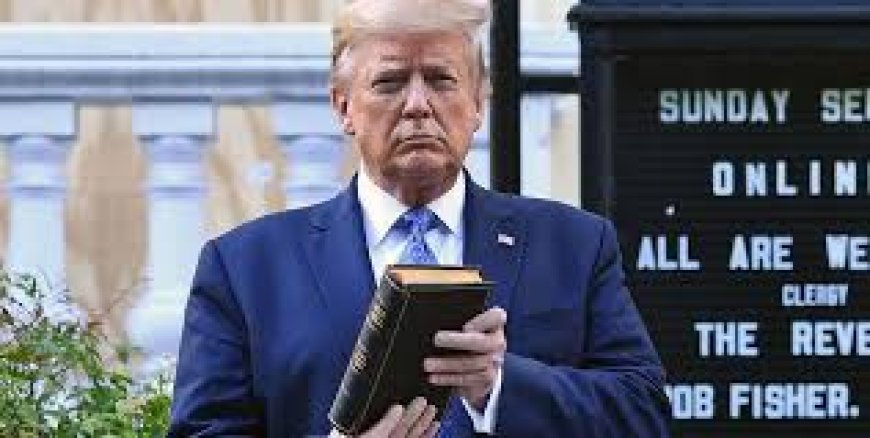
DONALD Trump has participated in a Bible-reading marathon a week after posting an AI image of himself as Jesus, reciting a passage from the Old Testament in a pre-recorded video filmed in the Oval Office.
Critics slammed the scripture reading as a blatant “political stunt,” while supporters praised the Republican president for reminding Americans “who we are as a nation.”
It comes as the Trump administration is fueling a religious resurgence in the federal bureaucracy. Since the president returned to office, federal workers have been inundated with proselytizing emails and invitations to worship services. And senior officials have repeatedly invoked their Christian faith in policy discussions.
The president has also sparred with Pope Leo over the Catholic pontiff’s staunch opposition to the Iran war.
Here’s what the president read
“And the Lord appeared to Solomon by night and said to him, I have heard your prayer and have chosen this place to myself for a house of sacrifice,” Trump said during his roughly three-minute address.
“If my people, which are called by my name, shall humble themselves and pray and seek my face and turn from their wicked ways, then will I hear from heaven and will forgive their sin and will heal their land,” the president, seated behind the Resolute Desk, continued.
The recitation is part of “America Reads the Bible,” a weeklong scripture-reading event featuring more than 500 participants, including Defense Secretary Pete Hegseth and Republican Senators Ted Cruz and Joni Ernst.
Organizers billed it as a "spiritual celebration of our nation’s founding ideals and a call to rediscover the truth that still anchors us today," according to the America Reads the Bible website.
“I applaud every citizen participating in the America Reads the Bible initiative,” the president said last week. “Together, we will honor Holy Scripture, renew our faith, usher in a historic resurgence of religion on American shores and rededicate the United States as one Nation under God.”
Mixed reactions
Social media quickly erupted with a range of reactions, with a number of users expressing heartfelt appreciation.
“This is what leadership looks like,” one X user wrote. “A president who isn’t ashamed to read the Bible in public and remind us who we are as a nation.”
“May God Bless what Trump is doing,” another chimed in. “In contrast…Biden honored gays.”
Bunni Pounds, the founder of Christians Engaged, the group that organized the project, also offered up praise. “It’s a powerful statement that he decided to read that passage,” she told The Associated Press.
Many of the comments, though, were far more skeptical of the president’s beliefs and motives.
“Anyone actually believe Trump has read the Bible? Even just one book? Of course not,” one X user wrote.
“Ha ha, first time for everything,” one added, while another decried the reading as a “political stunt.”
Brian Kaylor, author of “The Bible According to Christian Nationalists: Exploiting Scripture for Political Power,” rejected the popular interpretation that Trump’s passage is relevant to the U.S. political project.
“This verse is not about the United States,” Kaylor told The Associated Press. It is “a promise made to one particular person in one particular moment. It doesn’t really work to pull it out of context and apply it to whatever you want to.”
Broader emphasis on Christianity
The billionaire president has long cast himself as Christianity’s unrivaled defender. In 2021, he told a radio host that "nobody has done more for Christianity or for evangelicals or for religion itself than I have.” In 2024, he began selling Trump-branded Bibles.
Since returning to office, Trump has enacted a series of changes that have fueled a resurgence of religion within the federal government.
In February 2025, he established several faith-based offices across the government, including the White House Faith Office, headed by televangelist Paula White-Cain — who has compared the president to Jesus. And, in July 2025, the Office of Personnel Management released a memo permitting federal workers to “encourage” peers to “to participate in religious expressions of faith, such as prayer.”
Since then, employees across multiple agencies and departments have received proselytizing emails, invitations to worship services in government buildings and observed religious undertones in high-profile policy decisions.
The integration of religion — specifically Evangelical Christianity — into government operations has been most evident at the Department of Defense.
During a service in March, shortly after the outbreak of the Iran war, Defense Secretary Pete Hegseth implored God: “Let every round find its mark against the enemies of righteousness and our great nation.”
Since the Middle East conflict began, the administration has also found itself at odds with Pope Leo, the leader of the Catholic church, who has repeatedly condemned the war.
Last weekend, Trump fired off a striking 334‑word post on Truth Social in which he branded the pope “terrible” on foreign policy and claimed that the pontiff is fine with Iran possessing a nuclear weapon.
Shortly after, Trump posted an AI-generated image appearing to portray himself as Jesus healing a sick man. In response to bipartisan criticism, the president deleted the post and said he thought it depicted him as a doctor, not the Christian savior.
For his part, the pope has said he will not be silenced.
“I will continue to speak out loudly against war, looking to promote peace, promoting dialogue and multilateral relationships among the states to look for just solutions to problems,” Leo, the first U.S.-born Bishop of Rome, said last week.
“Too many people are suffering in the world today,” he continued. “Too many innocent people are being killed. And I think someone has to stand up and say there’s a better way.”
'If my people': Here's why the Bible passage Trump read aloud is so potent and polarizing
Associated Press
The scriptural passage that President Donald Trump read Tuesday evening in a livestreamed Bible-reading marathon dates back to the depiction of an ancient event — but it’s one that carries a highly charged significance in the current religious and political climate.
It has long been quoted and promoted by those who believe America was founded as a Christian nation and should be one. It's from the seventh chapter of 2 Chronicles, a book in the Hebrew (Old Testament) portion of the Bible.
The 14th verse — the one most often quoted — says:
“If my people, which are called by my name, shall humble themselves, and pray, and seek my face, and turn from their wicked ways; then will I hear from heaven, and will forgive their sin, and will heal their land."
Trump is among hundreds who are taking turns reading the entire Bible aloud over the course of a week. Most of the readings are taking place at the Museum of the Bible in Washington, though Trump's is coming by video from the Oval Office.
A passage often quoted at National Day of Prayer events
The Chronicles passage has for decades been a major theme at annual National Day of Prayer events. Organizers of the America Reads the Bible marathon invited Trump to read from it. “It’s a powerful statement that he decided to read that passage,” said Bunni Pounds, founder of Christians Engaged, which organized the project.
The passage has been recited over the decades at countless rallies, services and events, often organized around the disputed belief that America was created as a Christian nation and needs to repent of its sins and return to God. The passage has particularly been associated with annual events commemorating the National Day of Prayer, which has taken various forms since the mid-20th century and became fixed by law on the first Thursday in May since the 1980s.
The verse is set in a context far from modern America — during the reign of King Solomon in ancient Israel some 3,000 years ago. Solomon is presiding over the dedication of the first temple in Jerusalem, and in a lengthy prayer he asks for divine mercy if a future generation sins, is punished with military or natural disaster and then repents. In the key passage, God replies with a promise of restoration.
Critics say the passage is used out of context
But the use of the passage in modern settings has its critics.
The Chronicles passage is “a popular verse among Christian nationalists and has been for quite some time,” said Brian Kaylor, a Baptist pastor and president and editor-in-chief of Word&Way, a progressive site covering faith and politics.
He said its use has taken on a partisan and polarizing tone, often used in tandem with a promotion of a belief in a Christian America in an increasingly diverse country.
“This verse is not about the United States,” said Kaylor, author of “The Bible According to Christian Nationalists: Exploiting Scripture for Political Power.” It is “a promise made to one particular person in one particular moment. It doesn’t really work to pull it out of context and apply it to whatever you want to.”
But many have done so recently and in decades past, either saying America has a divinely ordained destiny similar to ancient Israel's or simply that they believe every nation has a duty to follow God and repent when needed.
President Dwight D. Eisenhower took the oath of office in 1953 with his hand on a Bible opened to the 2 Chronicles passage. President Ronald Reagan quoted the passage in a proclamation declaring 1984's National Day of Prayer. A speaker at the 2024 Republican National Convention also quoted it.
The National Day of Prayer, while officially nonsectarian, has long been drawn particular promotion and participation from evangelical Christians. Readings of the “If my people” passage has been a staple of such events.
Politicians, others joining in the Bible-reading marathon
Evangelicals — a loyal Republican voting bloc for decades — have formed a crucial part of Trump's electoral base. His rallies have featured a fusion of Christian and national symbols and rhetoric, featuring songs like “God Bless USA” and T-shirts with slogans like “Jesus is my savior, Trump is my president.”
Many other Republican politicians are taking part in the Bible reading, along with celebrities, pastors and others. And Trump isn't the only one reading a passage significant to his office or mission.
Mike Huckabee, a Baptist pastor and U.S. ambassador to Israel, is reading from a Genesis passage in which God says he will bless those who bless Abraham — a passage popular with many evangelicals who believe they have a biblical mandate to support Israel.