



































































China is attacking the foundations of the US economic boom
TIM Creswick, a London-based technology entrepreneur, spent much of last week tinkering with a collection of half a dozen AI bots he uses to run his personal life.
Among the AI in his toolkit is Qwen, a cheap Chinese system from Alibaba, which he runs on his own Nvidia processors.
Relying on Qwen for simple tasks or routine coding has “more than halved” the amount he is spending on more powerful models, such as those from Anthropic and OpenAI.
Using the most powerful “frontier” bots from Anthropic or OpenAI to sort your emails or write some notes is a bit “like using a Ferrari to pick up the shopping”, Creswick says.
Like many founders who live and breathe AI, Creswick has found Chinese bots to be a useful tool to keep costs down. Their popularity is growing fast.
But, as the tech world awaits Claude developer Anthropic’s $2tn (£1.5tn) stock market float, the rapid advances of Chinese rivals are casting a shadow over Silicon Valley.
Beijing-based Moonshot, the company behind the Kimi bot, is said to be preparing a float that would value it at up to $50bn early next year.
DeepSeek, a Chinese lab with its own eponymous chatbot, is plotting its own float and was lately valued at almost $75bn.
Both DeepSeek and Moonshot were founded just three years ago. OpenAI took close to a decade to reach a similar valuation.
Their growth comes amid growing pressure over US tech valuations. The Nasdaq dropped close to 3pc on Friday while Google’s parent company recorded a record $500bn sell-off a day earlier, driven by growing unease that the spending plans of the AI industry will fail to translate into sustainable revenues.
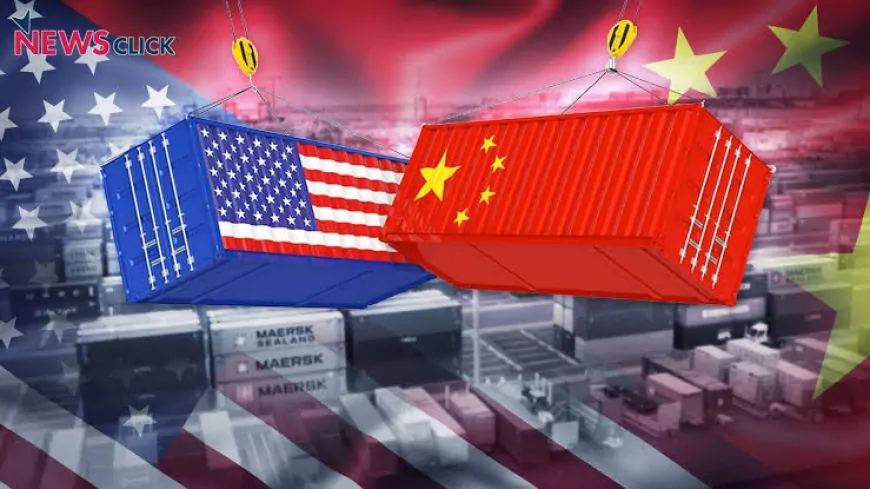
Chinese AI companies pose a key threat. While they remain a step behind Anthropic and its rival OpenAI in terms of performance, they have been seeking to usurp Silicon Valley’s market dominance by making AI cheaper than ever.
And although Anthropic’s most powerful technology is widely regarded as still being a cut above the best that China can offer, the gap has been closing. The US’s lead over China was once a year, then six months and now perhaps just weeks.
Both Anthropic and ChatGPT developer OpenAI have been forced to trim their prices in response to China’s brutal price war.
More fundamentally, China has pioneered work on so-called “open-weight” AI tools, which can be freely downloaded and tweaked by users.
Those with some technical knowledge can run them on their own hardware, rather than via the cloud, bringing down costs further.
Last week, DeepSeek revealed a new open-source AI system known as DeepInfer. It effectively offers free access to technology the company uses in its internal AI systems, aimed at helping businesses and expert users to bring down their costs.
Silicon Valley’s leading AI tools, on the other hand, are normally run on systems with guardrails and settings tightly controlled by the labs themselves.
Anthropic did not name either Kimi or DeepSeek as potential rivals in its stock market filing last month. Yet the US lab admitted that open-weight AI could “capture a portion of the market for certain use cases” and “exert pricing pressure on our offerings”.
Neil Shah, an analyst at Counterpoint Research, says some Chinese systems can deliver the same performance at an “80pc to 90pc cost advantage” and are driving down prices faster than expected.
These “dirt-cheap” AI tools “severely limit the pricing power of US labs”, he says.
Kyle Chan, a China expert at the Brookings Institute, adds: “For most AI users, Chinese models offer ‘good enough’ capabilities but at lower costs.”
Investors are now weighing up whether Anthropic and OpenAI’s lead is unassailable, or whether China’s cut-price approach could undermine Silicon Valley companies.
Chris Wood, an analyst at Jefferies, says: “The most likely longer term outcome of the AI story in market terms will be massive capital destruction in the US, with market share going to cheaper, open-source Chinese large language models.”
Anthropic alone is committed to spending more than $550bn on data centres and other infrastructure.
Fears about the impact of Chinese AI on US businesses are not new. When DeepSeek’s technology was first revealed in January 2025, it triggered a market sell-off because of concerns its lower running costs could undermine America’s AI boom.
Founded by Liang Wenfeng, a hedge fund trader, DeepSeek’s launch prompted Nvidia’s stock to fall 17pc in a single day, wiping nearly $600bn from its value, a record amount.
Since then, US AI chip giants and hyperscalers have been driven to still-higher valuations but investors have watched for signs China could unleash another market rout.
Anthropic and OpenAI have largely vied for the top spot on AI leaderboards, with their bots’ coding capabilities driving a wave of adoption by businesses.
But China’s bots have proved they can do much of the same work for significantly less investment.
In July, China’s Kimi caused a fresh Wall Street rout after its technology appeared to catch up with some AI bots on offer from Anthropic.
Moonshot, its developer – which is led by Yang Zhilin, a baby-faced 34-year-old – has since followed up with a series of powerful new releases.
Its most powerful system, K3.1 Pro, costs about $1.98 for an intensive task, according to a report from Artificial Analysis. Anthropic’s Fable, while slightly more powerful, comes in at as much $7.63, while OpenAI’s Astra costs $3.26.
Perhaps more significantly, millions of “tokens” – the building blocks of AI systems – for China’s budget AI tools can cost as little as a few pence. Some are tens or even a hundred times cheaper than the top models of US rivals.
For “most real-world work, the best open-weight models are already good enough”, says Bilal El Alamy, of French investment firm Pyratz, an investor in Moonshot.
“For the large majority of what companies actually do day to day, you do not need the single most capable model in the world.”
In response, Anthropic and OpenAI have trimmed the costs of some of their less powerful AI tools. In September, they cut the costs of some of their cheaper systems by between 40pc and 50pc.
However, this has only stoked fears that US trailblazers will struggle to recoup the massive upfront investments they have made in the technology.
China is also not immune from wider fears that AI valuations may be overcooked. Since the summer, some $500bn, or 40pc, has been knocked from China’s leading Star index.
Large Western companies may be unwilling to risk their data with a Chinese AI giant. Indeed, Chinese AI companies have been caught building their systems by aggressively “distilling” rival chatbots, effectively reverse engineering systems from Anthropic and OpenAI by bombarding them with questions.
Anthropic has moved to cut off this access and it bans users from China, although ironically the crackdown could hit its own revenues.
US officials have also threatened to crack down on Chinese AI labs. In September, Scott Bessent, the US Treasury secretary, accused China’s companies of “industrial-scale” theft from Silicon Valley labs and threatened sanctions on them.
Still, it is hard to argue with the economics. For mundane tasks that don’t involve sensitive data or code, “I just don’t care if I am sending it to China”, says Creswick.
Just how many people feel the same and how much work they are willing to do with Chinese AI will be closely watched as Anthropic prepares to join the stock market.