



















































































A scientist may have just solved the mystery of the Great Pyramid
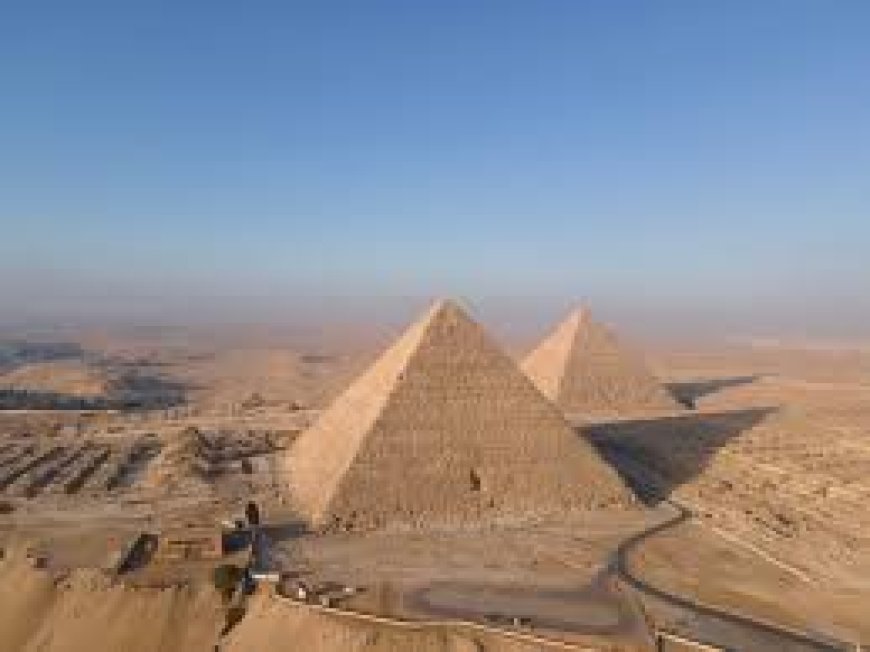
THE Great Pyramid has seen the rise and fall of powerful dynasties for 4,600 years. It was built as a tomb for the Fourth Dynasty Pharaoh Khufu, but the circumstances of precisely how it was built have eluded archaeologists for centuries. Theories have ranged from practical to mechanical and even extraterrestrial.
But no, it wasn’t aliens.
When computer scientist Vicente Luis Rosell Roig endeavoured to analyse whether or not any of these theoretical construction methods could actually have been put into action thousands of years ago, he saw an issue with a prominent theory that ramps had been employed to aid in the pyramid’s construction.
If a single ramp had been used to push monstrous limestone and granite blocks, each weighing two and a half tonnes, it would have impeded progress due to being too steep and only allowing one team of workers to transport a stone at once. The spiral ramp theory accepted by most Egyptologists allows for more teams to ascend and descend, but that still means the ramp itself would have been protruding from the walls.
Rosell Roig ultimately landed on another solution. If the spiral ramp were built into the pyramid and then covered with stone blocks from the top down as it was completed, nothing would be left to remove. There would be no visible traces of it left behind.
To test this theory, Rosell Roig created an algorithm that maximised efficiency by coming up with the best possible angle and number of repetitions for the ramp. Too many repeating parts of the spiral would compromise the integrity of the pyramid.
“Old Kingdom technology precluded iron tools, wheeled heavy transport, and compound pulleys but allowed copper chisels, water-lubricated sledges, ropes, levers, earthen works, and Nile barges,” Rosell Roig said in a study recently published in NPJ Heritage Science.
“Accordingly, we bound ramp slope, lane width/clearance, and friction, and evaluate the dispatch headway (time between placing successive blocks) required to satisfy the 20–27-year window, encoding these constraints as model parameters.”
The Great Pyramid’s base is about 755 feet (230 meters) on each side and rises to a height of about 481 feet (147 meters). It is thought to be constructed from some 2.3 million blocks. Completing it during the reign of Khufu meant that one block needed to be added approximately every three minutes. Rosell Roig’s algorithm needed to account for this fast pace.
To fill in the blanks, such as how the blocks would have been transported from the quarry to the building site, Rosell Roig relied on a primary source. The Wadi al-Jarf Papyri, especially the chronicles of an inspector known as Merer, who manned a cargo barge, show how builders took advantage of Nile floods to deliver the blocks to the pyramid site as fast as possible.
The papyri provide evidence that construction was performed by multiple teams of workers that were given group names, with Merer’s team distinguished by a lion hieroglyph. This could mean that each block would be added by a different team in each of the four parts of the ramp winding around the pyramid.
By transporting the blocks up a gently sloping spiral ramp, the ancient Egyptian work teams would have added one new block to the pyramid every three minutes. Wider spaces for edge turns would have also reduced interference between different teams to a minimum.
Rosell Roig thinks front access to each ramp would have given workers a shorter distance to transport blocks, and adding wet sand would have facilitated pulling loaded sledges up the ramps, minimising construction time.
“This framework of harbour, distribution system, and large labour pool fits Khufu’s ~27-year reign yet remains flexible, since base-level phases could lengthen without invalidating estimates,” he said. “Future work should test these assumptions via geophysics for stockpile lenses, mapping corner-platform wear, and edge surveys.”
So, with the help of an algorithm, Rosell Roig has worked out a possible answer for how the pyramid was built—no aliens required.